Manhattan Portage Atlas Sling: From Crowdfunding to Retail Catalog
How I identified a competitive whitespace, validated demand through crowdfunding, and built a repeatable go-to-market system that scaled across three product generations with Manhattan Portage.
Category
Product Development & GTM Strategy
Disciplines
Product Development, Go-to-Market Strategy, Crowdfunding, Competitive Positioning, Press & PR, Customer Research
Client
Manhattan Portage
Year
2019 - 2024
Context
EverydayCarry.com was a product education platform, not a gear brand. Manhattan Portage was a legacy luggage company with deep manufacturing credibility but limited presence in the EDC and everyday tech carry space. Both sides had something to prove.
The goal was to find a product that made sense for both audiences, validate it before committing to full production, and then build a content system that could carry it from crowdfunding through retail across multiple versions without losing the thread.
The Challenge
How do you take a legacy luggage brand into a new product category and convince a skeptical audience that it's worth backing before the product even exists?
Two credibility gaps, one product. EDC’s audience trusted the platform’s product knowledge, but they’d never seen EDC put its name on a physical product. Manhattan Portage had decades of manufacturing behind it, but the brand had no presence in the carry enthusiast conversation.
The competitive landscape reinforced the opportunity. No product in the EDC space was explicitly designed to work as both an organizing pouch and a crossbody sling. Most slings were too large to double as pouch organizers. Most pouches lacked proper sling hardware. And nearly everything in the category leaned heavily tactical: MOLLE webbing, heavy-duty hardware, overtly military aesthetics. The Atlas Sling needed to signal authenticity to the EDC community without alienating a broader audience.
The solution had to do two things at once: validate demand before committing to production, and tell the design story in a way that earned trust from people who would actually buy it. That meant the content couldn’t be marketing. It had to be education.
Strategy
The positioning evolved with each generation, but the system stayed the same: content-led education to build trust, owned channels for depth, and real customer feedback to drive the next version.
V1 was built on two signals. First, hundreds of UGC submissions on EverydayCarry.com showed pouch organizers as a dominant carry pattern, people were already solving this problem with workarounds. Second, firsthand observation in Asia showed that small crossbody bags were already mainstream for men. Manhattan Portage made sense as a partner because the brand was already popular in Asian markets and had decades of manufacturing credibility. The positioning was simple: the bag that doesn't exist yet, for a use case that clearly does.
V2 kept the same identity but addressed the core usability complaint. V1's highly organized layout invited people to insert more gear, but the bag became less functional the more stuffed it got. The fix was targeted: expand the spine for more volume and breathing room while keeping the same footprint and organizational layout.
Pro shifted the target entirely. Premium pricing required premium positioning. The bag carried both Manhattan Portage's Black Label designation (their highest tier) and Green Label (recycled, sustainable materials). Messaging moved toward the power tech user and longer-haul traveler, people who were likely to spend more on niche, functional gear.
Crowdfunding validated V1. Sales velocity validated V2. A full retail launch validated Pro.
Execution
Phase 1: Crowdfunding Validation — Oct-Nov 2019
$26K raised
523% of goal
316 backers
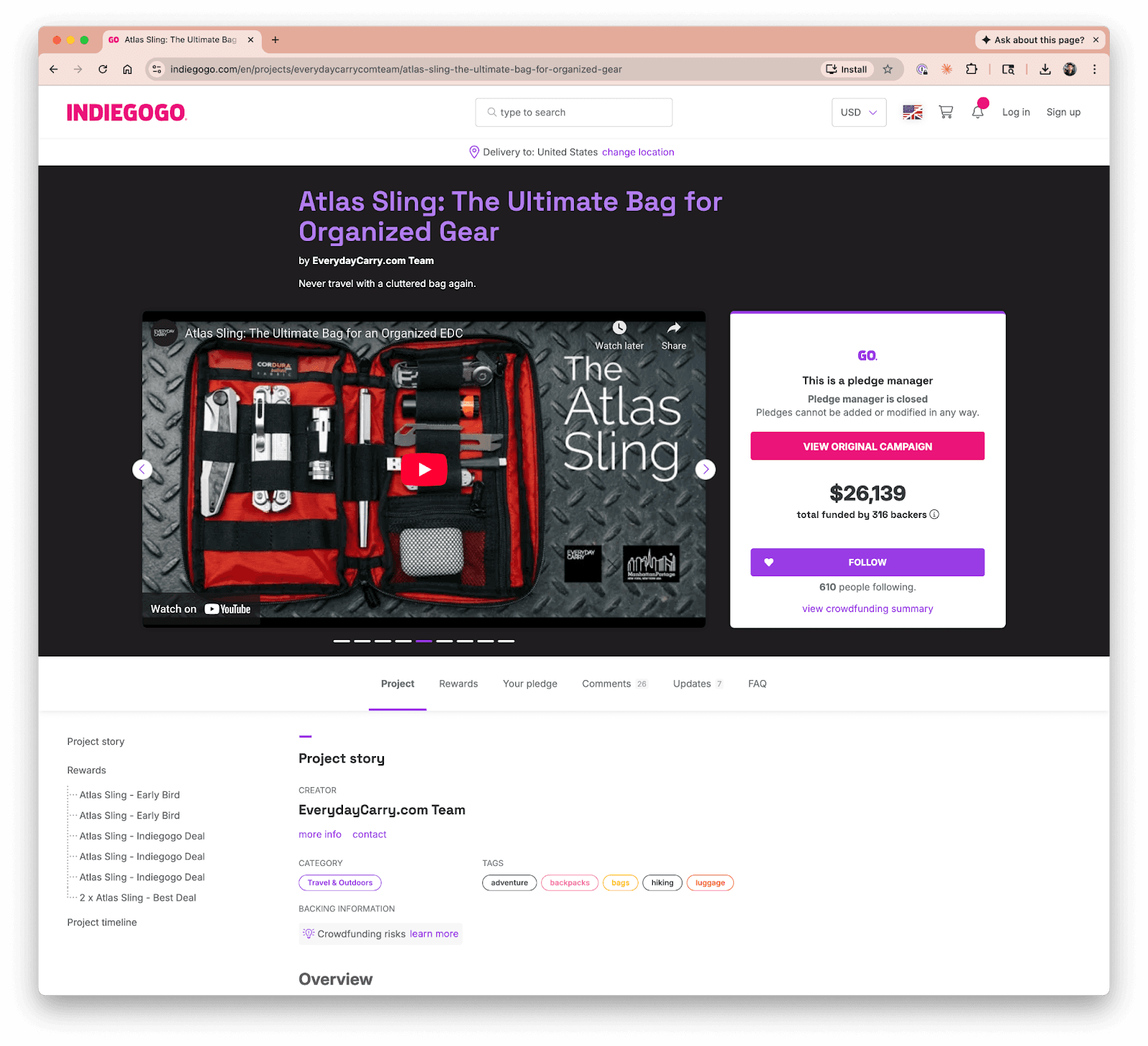
The Indiegogo campaign was end-to-end: I was the executive designer on the product itself, the author of the campaign page, and the face of the campaign in video. The page needed to do two things at once. Educate people on what a modular sling actually was for, and make the case that this specific one was worth backing. Every section was written with that dual purpose.
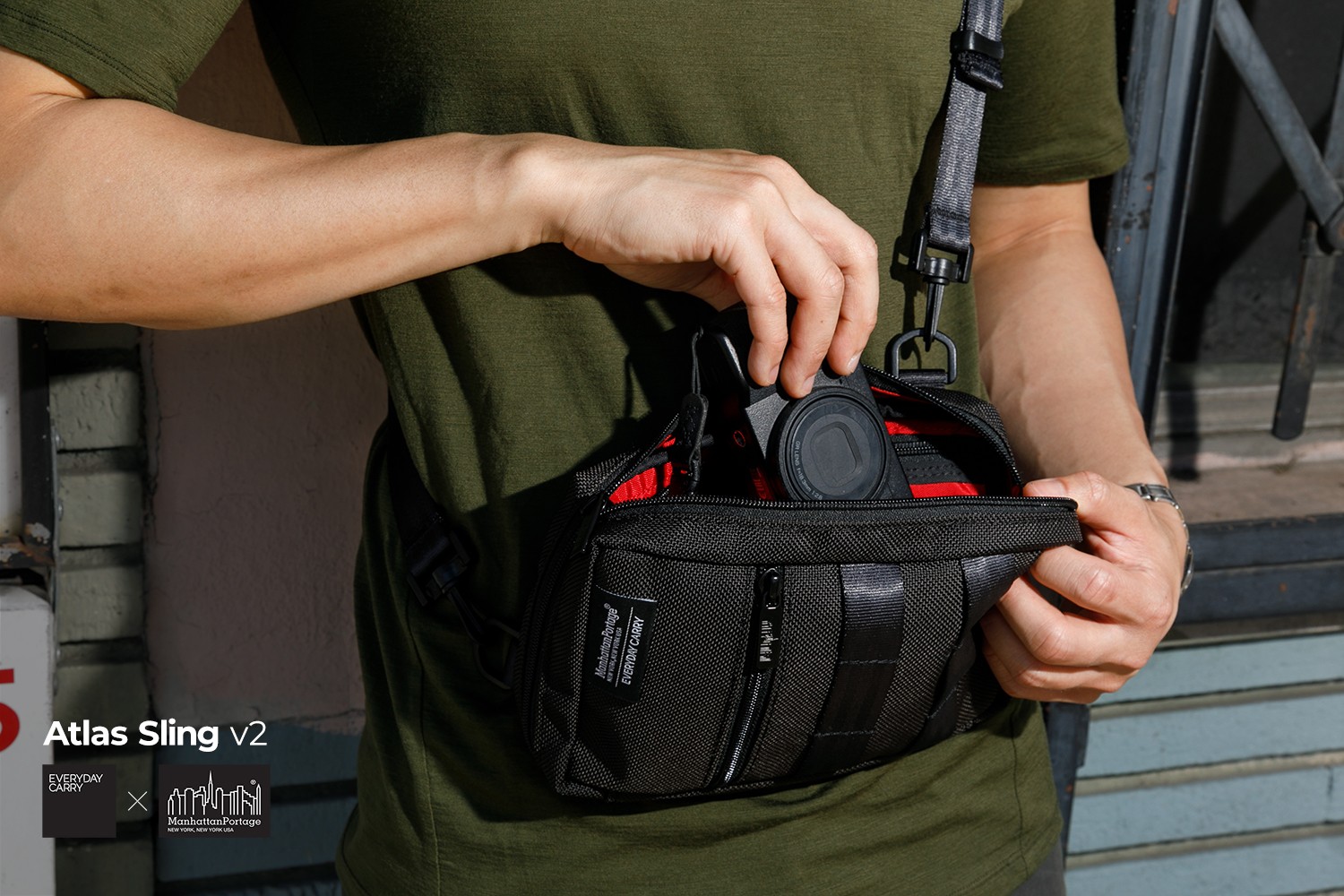
As executive designer, I chose industry-proven, enthusiast-approved hardware and materials but was more restrained with the implementation than most competitors. Tactical elements like webbing loops were used as nods to EDC authenticity, not as the product's identity. The styling in campaign imagery paired the bag with props that signaled credibility to hardcore EDC users while remaining relatable enough for a broader audience to see themselves carrying it.
The campaign closed at $26,139 raised from 316 backers, 523% of the $5,000 goal. The average pledge of $82 on a product that would retail for $66 showed that backers were buying the vision, not hunting for a discount.
The press picked it up independently. GQ named it one of the "20 Best New Menswear Items" that week. Field Mag ran a feature. Neither was sponsored. The product story was strong enough to earn coverage on its own.
Phase 2: V2 Launch — Aug 2021
83 of 250 sold in 26 hours
60% sell-through by day 5
80% sell-through by day 19
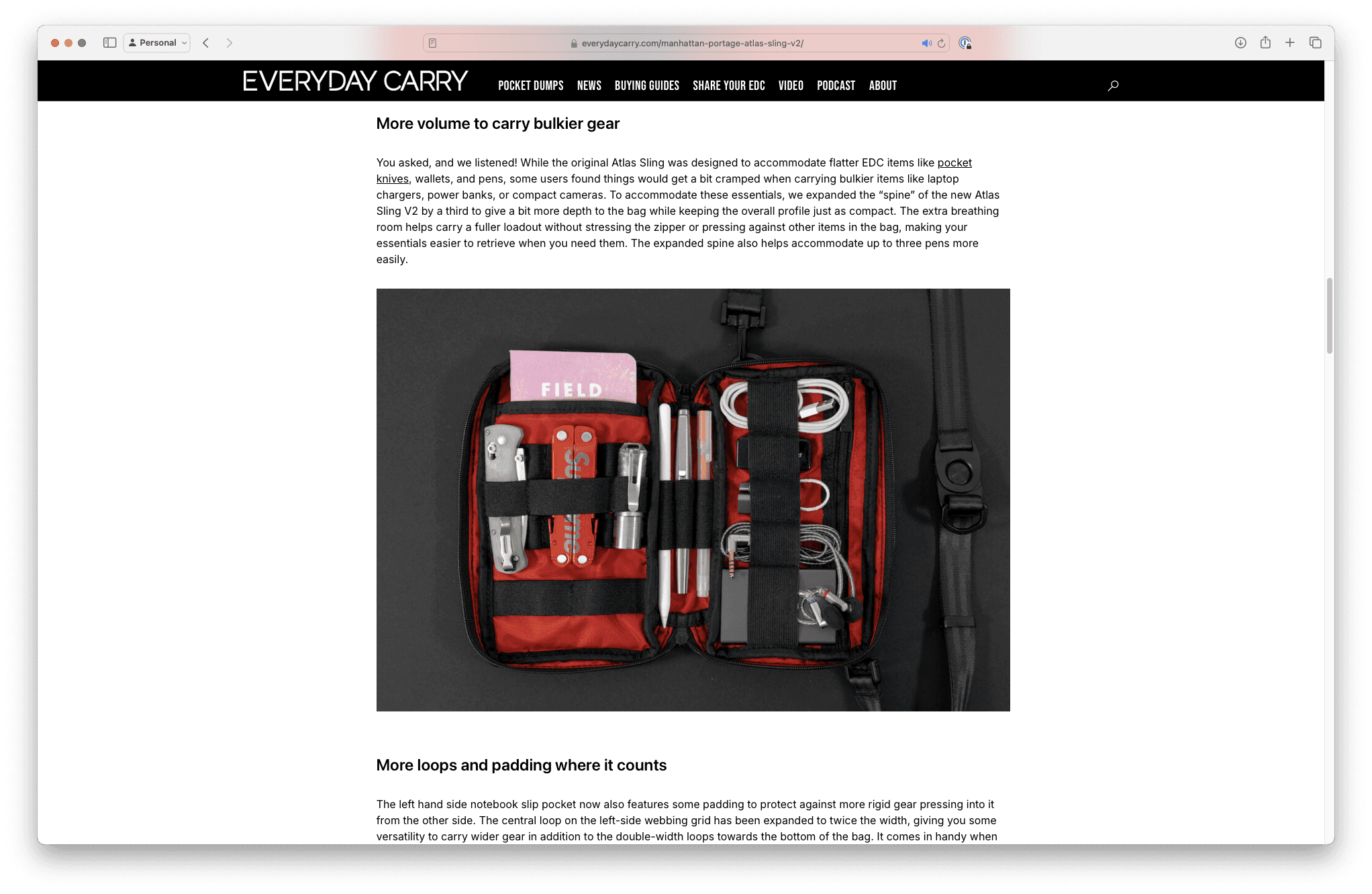
V2 happened during lockdown, which meant all production and photography was done in-house with friends and family helping on set. But the constraints sharpened the focus.
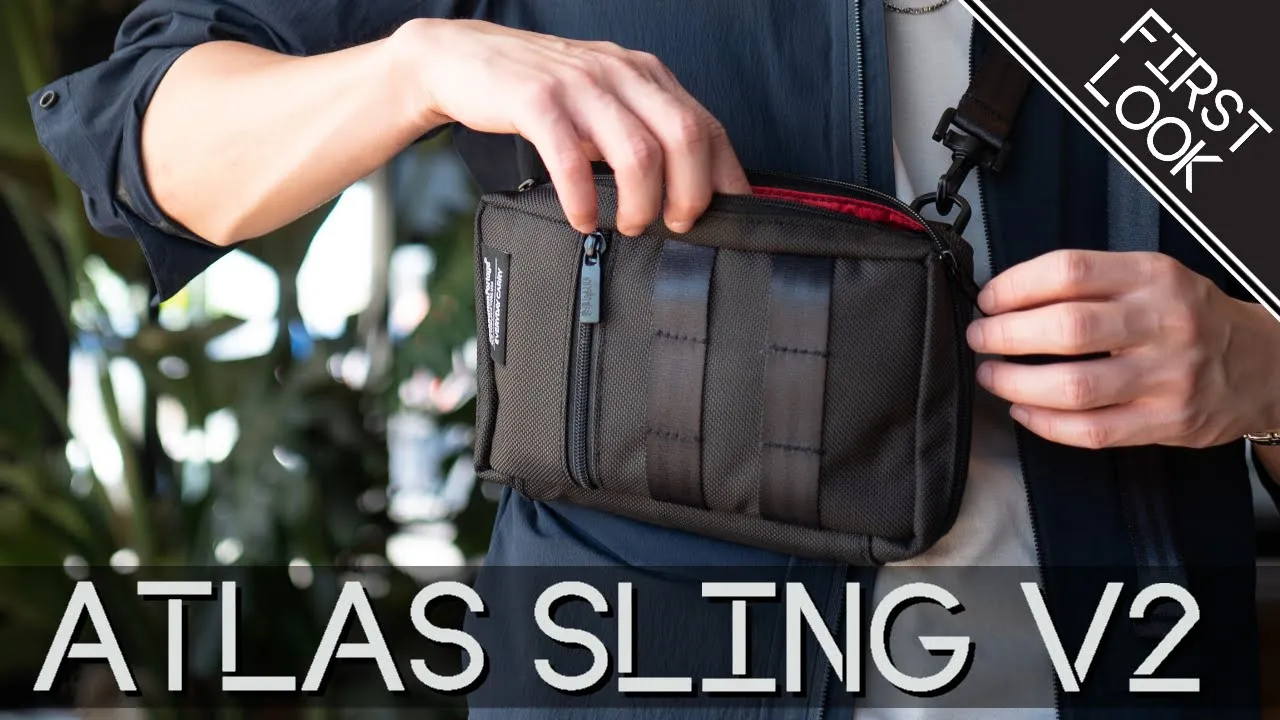
The design changes came directly from customer feedback that Manhattan Portage had gathered through reviews and support channels. The core issue: V1's highly organized layout invited overstuffing, and the bag became less usable the more packed it got. Since we'd designed for "just the essentials," this wasn't on our radar. The fix was targeted: expand the spine by a third for more breathing room while keeping the same footprint and organizational layout. The webbing grid loops widened, and the rear pocket got a passthrough strap design so the bag could double as a pouch organizer without losing cargo space.
The editorial post led with "You asked, we listened" and walked through every change with before/after specificity. That transparency was the point. The audience was paying attention to the design decisions, and the content proved the feedback loop actually worked.
The results were immediate. In an internal email 26 hours after the V2 launch, Manhattan Portage's team reported 83 of 250 units sold, noting: "every time y'all post about it, it sells a little bit more." By day five, sell-through hit 60%. By August 30, it was 80%.
YouTube comments on the V2 review reflected the same signal: "ordered my bag today," "thoughtfully designed, gonna pick one up," and eventually "please restock" and "when will be back in stock?" One commenter's detailed feedback about excess strap management directly informed the Pro's redesigned strap system two years later.
V2 also earned the strongest customer validation of the three: 17 five-star reviews on Manhattan Portage's site and enough demand to justify the most colorway options in the lineup.
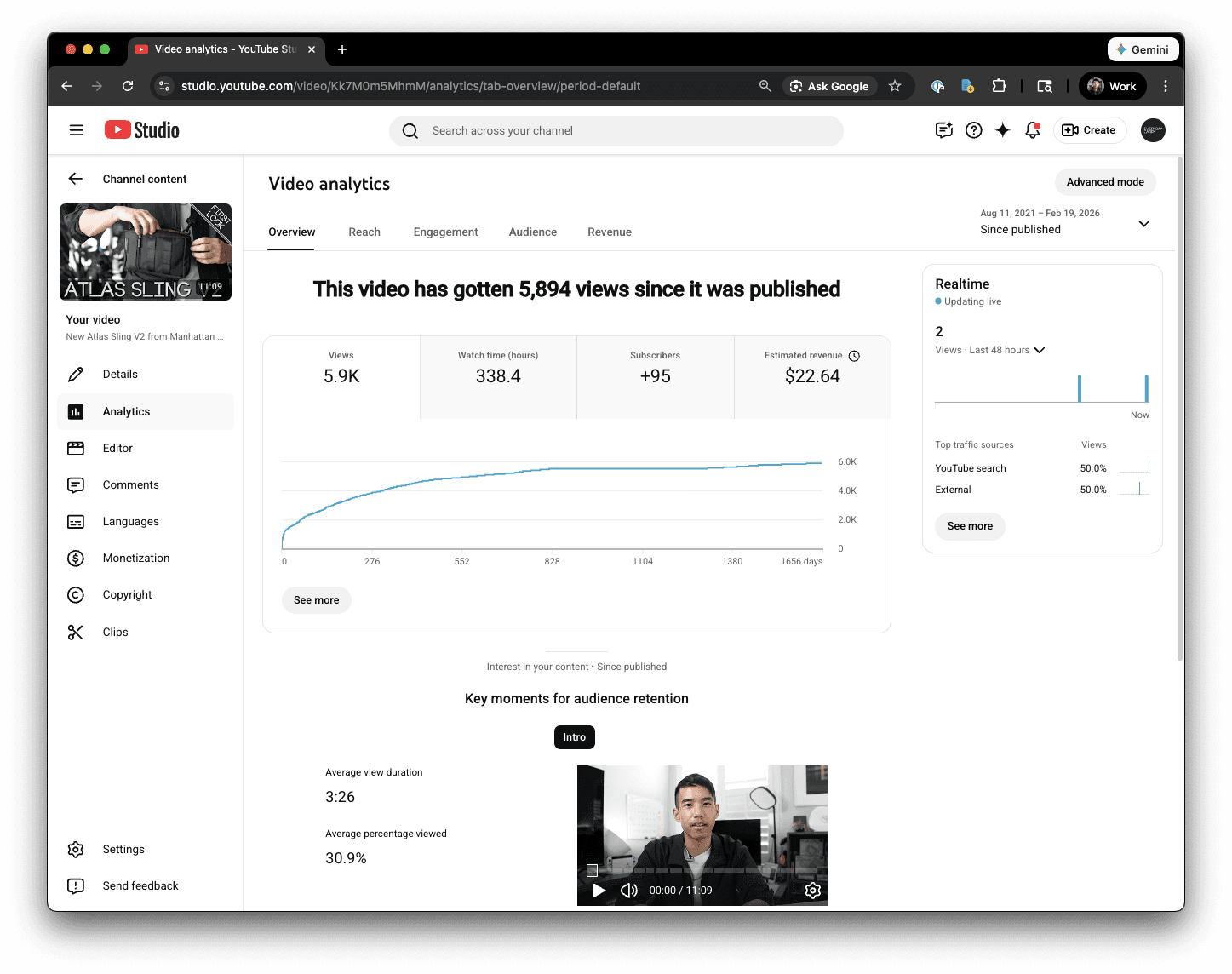
The V2 longform review generated 338 hours of watch time with an average view duration of 3:26, reinforcing the product education approach that was driving the sales velocity.
Phase 3: Atlas Sling Pro — Aug 2023
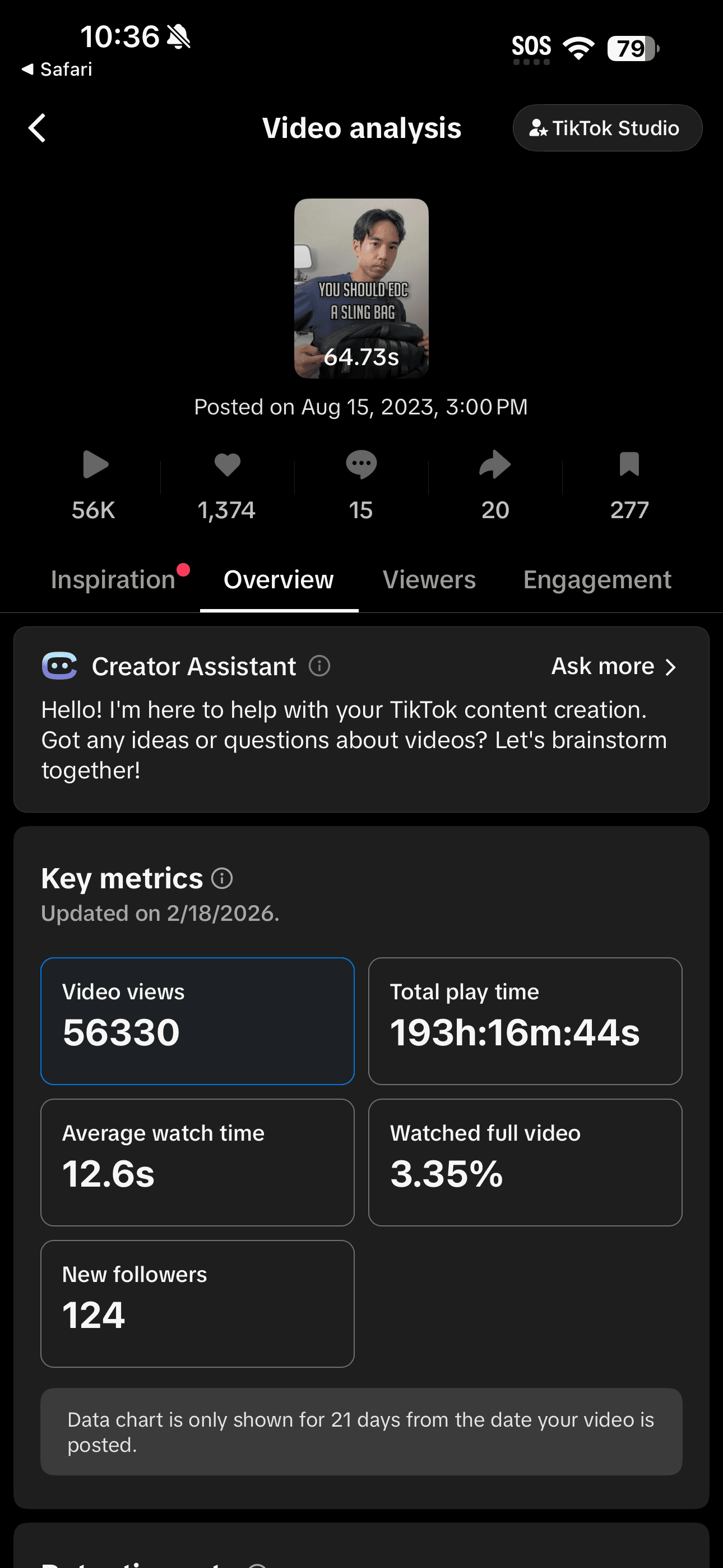
494k views
2001 saves
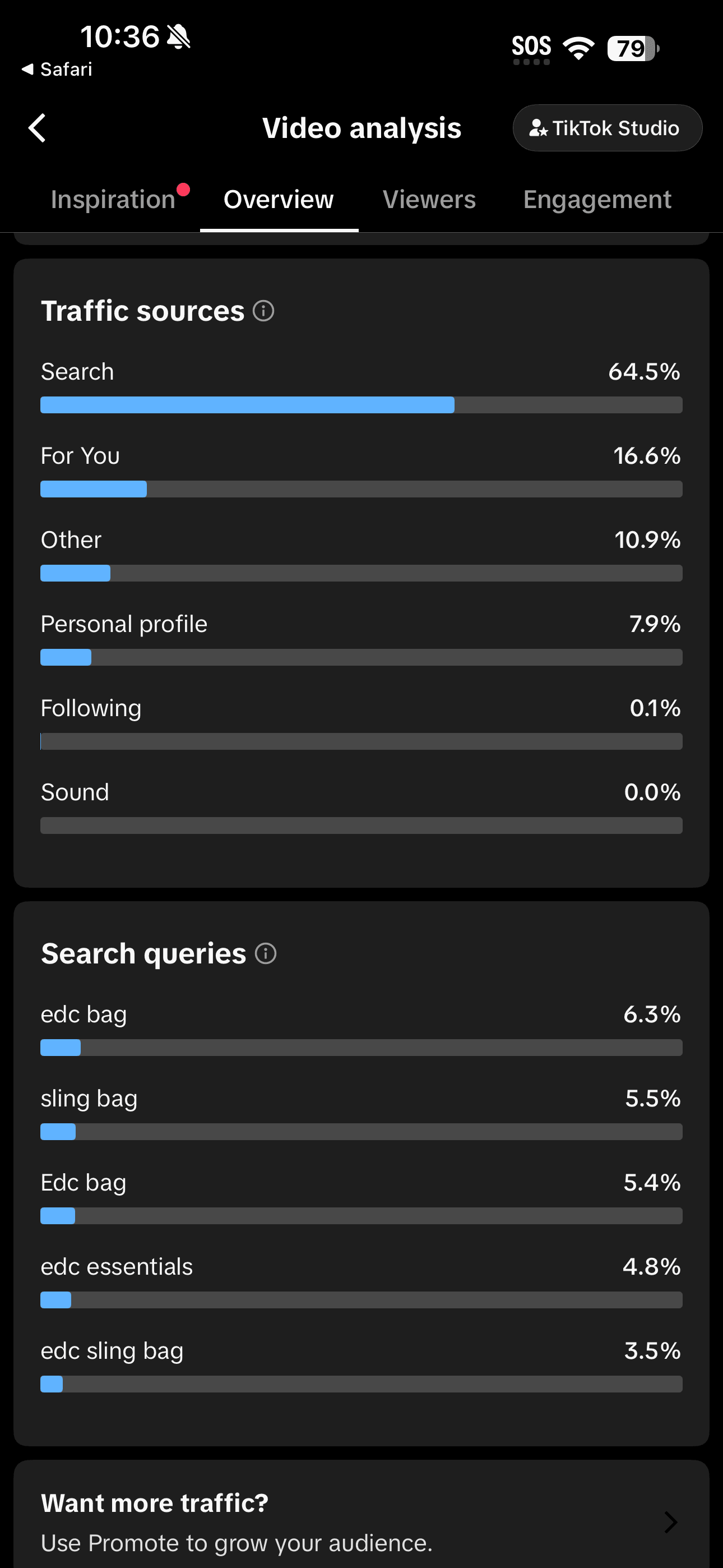
64.4% search traffic
Manhattan Portage's 40th anniversary was the hook, and the product was a genuinely new silhouette, not another iteration. The foundation was MP's Ironworker Sling, a Black Label product at 8L capacity. The design took over a year. It added a dedicated tablet sleeve for up to 11-inch screens, four pull handles, internal and external loop fields, and volume pleats in the main compartment.
The $199 price point (compared to V2's $89 at launch) reflected the manufacturing complexity, premium materials, and added functionality. The dual designation of Black Label and Green Label gave the messaging two justification levers: MP's highest product tier and their commitment to recycled materials.
The content scope matched the ambition: 13 posts across TikTok and Instagram in a single month, a longform YouTube review, creator seeding with tight briefs, and PDP assets written for the retail page. I was also on-camera talent for MP's own content while continuing to run EDC's owned content in parallel.
I selected creators for rigor over reach. PackHacker and Dannypacks were well-respected reviewers in the bag community with discerning audiences who matched the product's target buyer. The briefs were minimal by design. I didn't need them to push a particular message. The product was strong enough to stand on its own, and I wanted independent validation, not scripted endorsements. They were free to review as critically as they wanted.
Results
Sales Velocity
33% sell-through in 26 hours. 60% by day five. 80% by August 30. On a 250-unit V2 run where content was the primary driver. Manhattan Portage confirmed the correlation in writing.
Content as Product Discovery
494K combined views and 2,001 saves across 13 shortform posts during the Pro launch. The standout signal: 64.4% Search traffic on the top-performing TikTok, meaning the content was functioning as product infrastructure, not just reach.
Partnership Durability
Five years. Three silhouettes. Both the V2 ($119) and Pro ($199) are still in Manhattan Portage's catalog today. Most brand partnerships last one campaign cycle. This one built a product line.
Press Validation
GQ "20 Best New Menswear Items" (2019). Field Mag feature with quoted interview (2019). Pack Hacker review, 7.3/10 (2023). TheAwesomer feature (2021). All independent editorial, no sponsored content.
Additional Supporting Assets
Website Posts
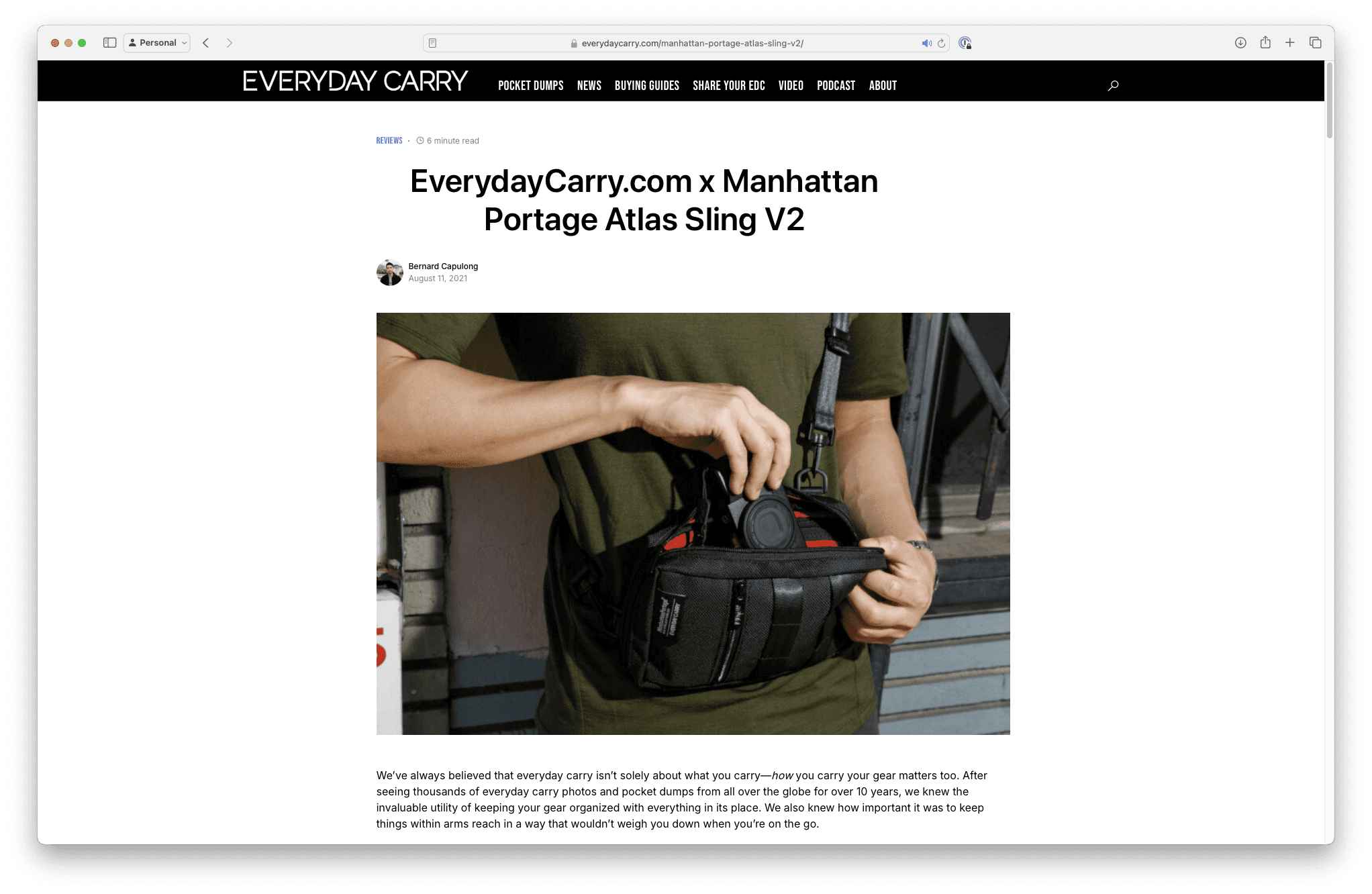
V2 editorial post on everydaycarry.com
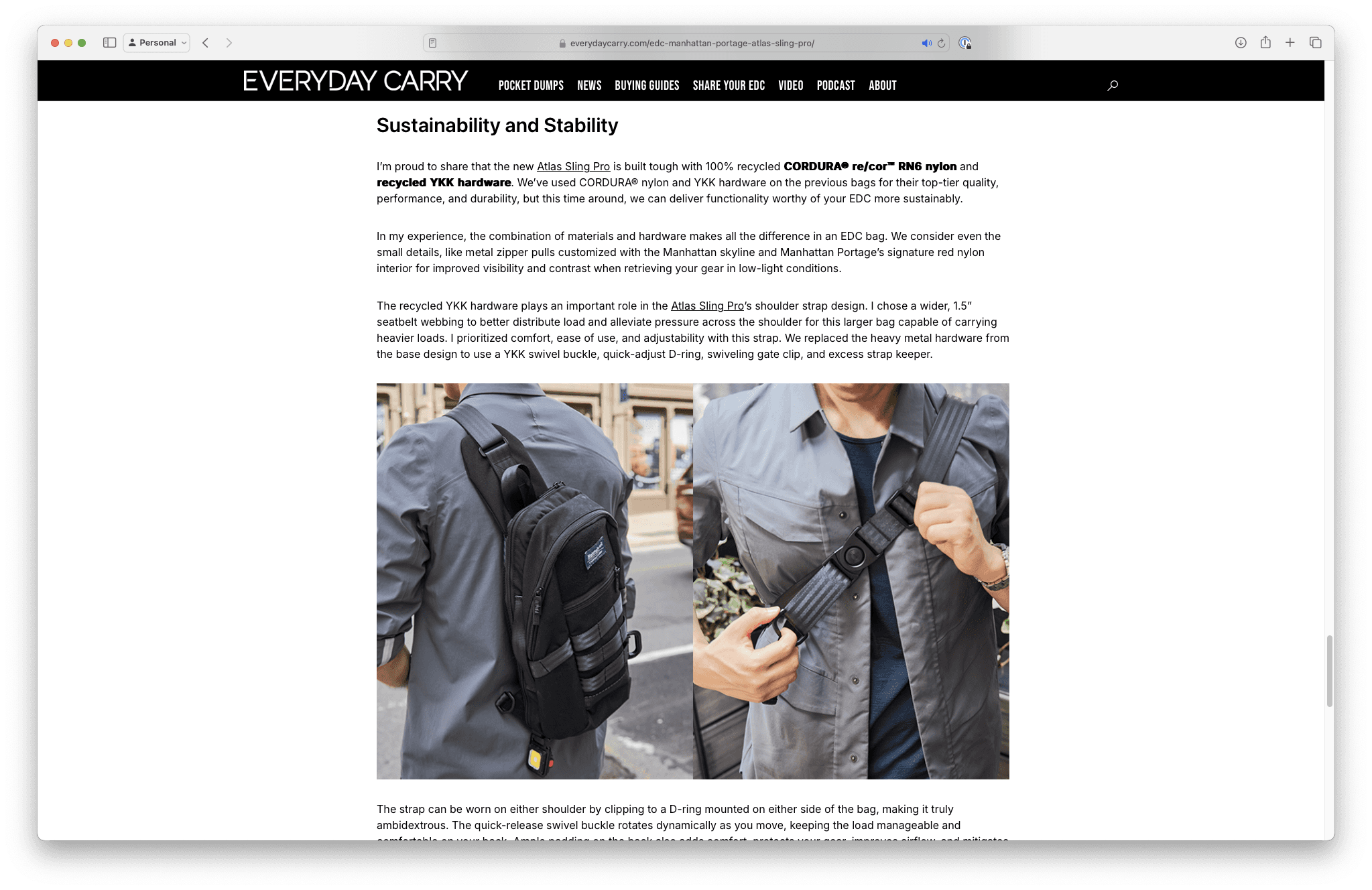
Pro editorial post on everydaycarry.com
Product Education Videos & Analytics
V2 longform review (5.9K views, 338 hrs watch time, 50% YouTube Search)
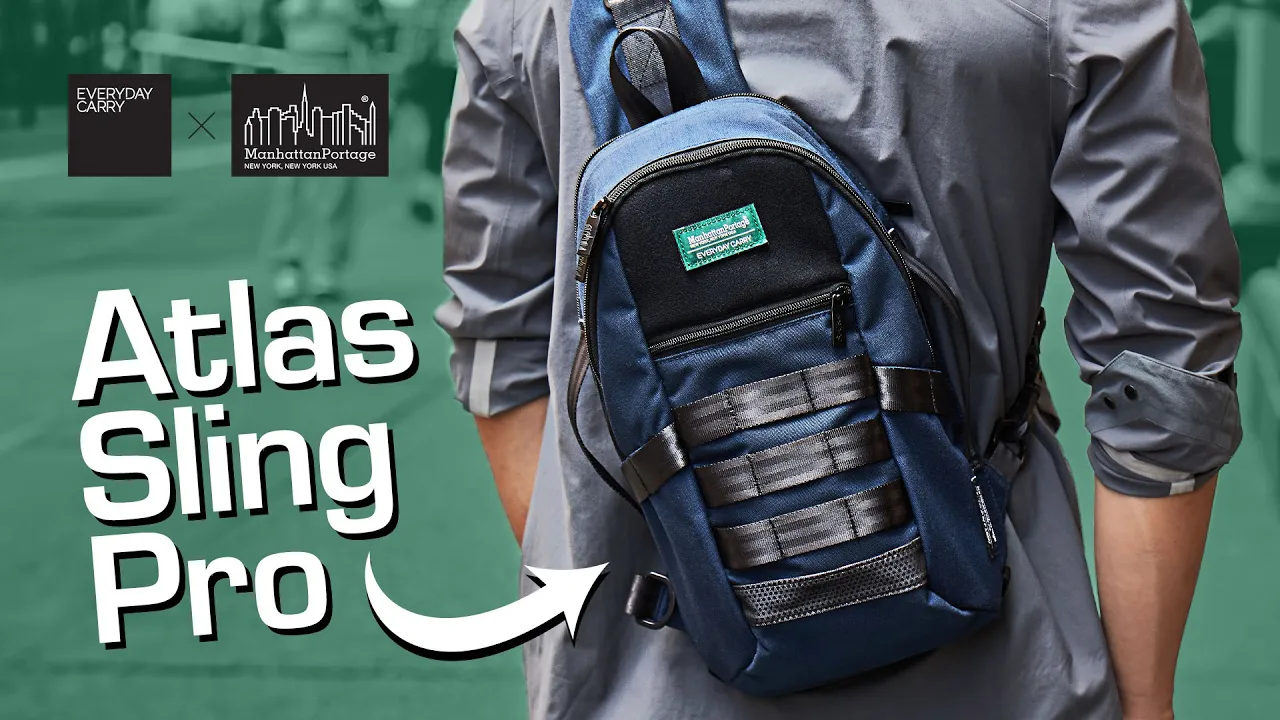
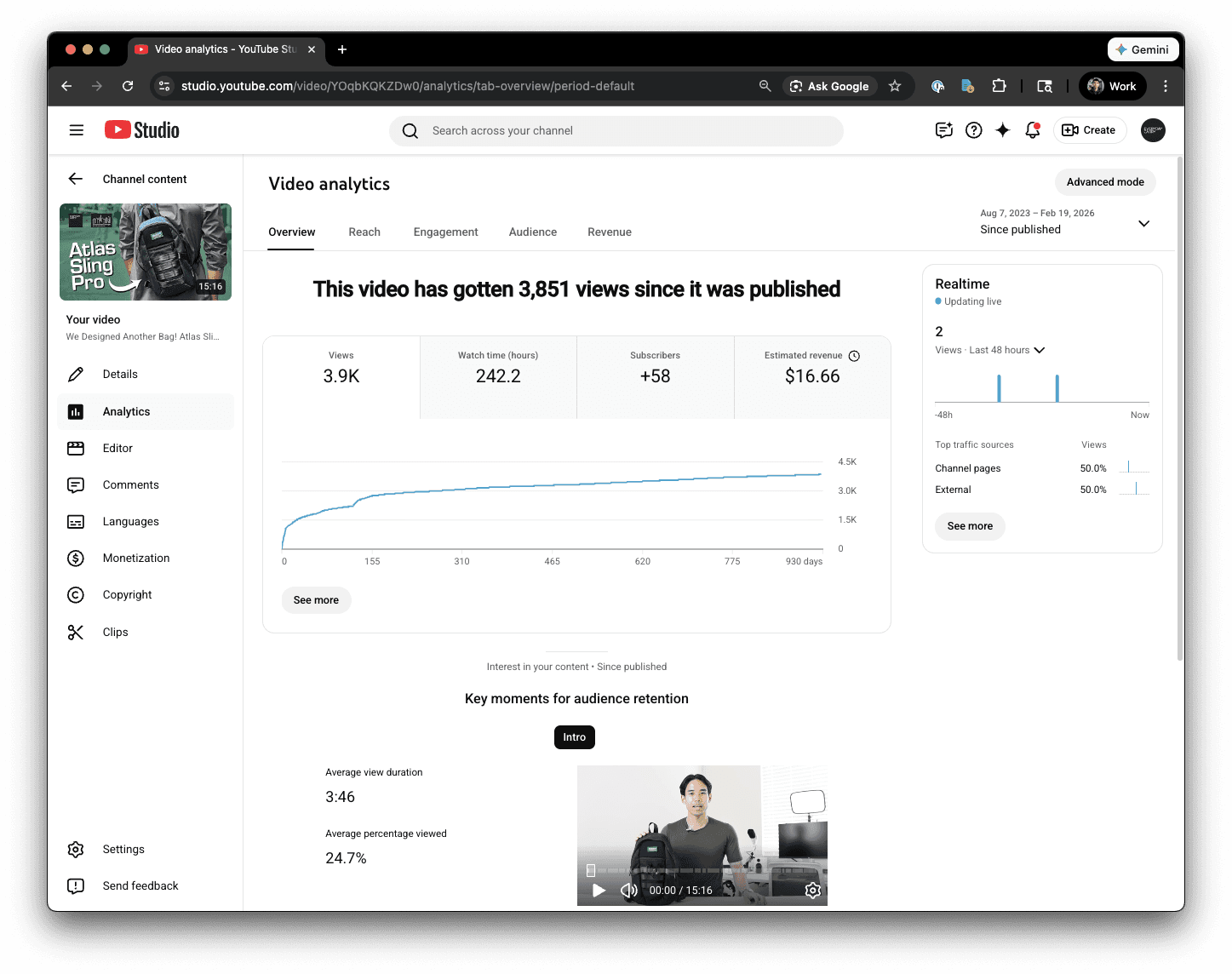
Pro longform review (3.8K views, 241 hrs watch time)
Influencer Marketing Content & Press Hits
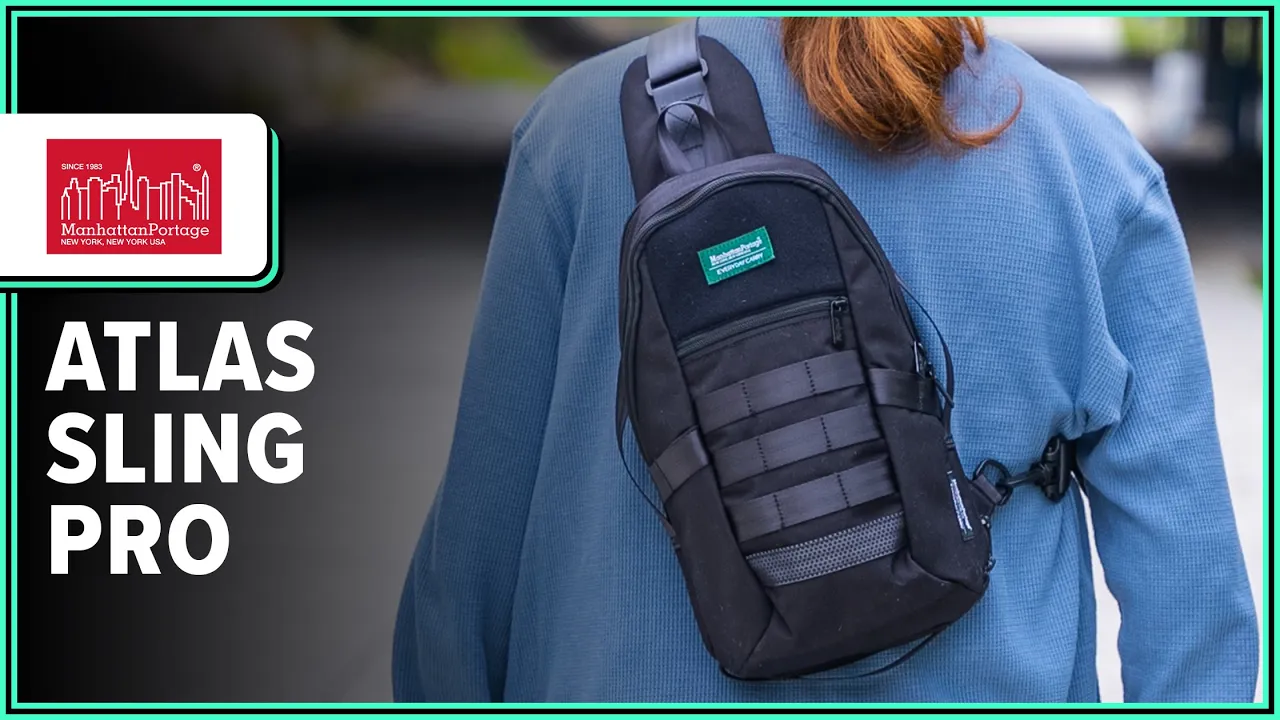
PackHacker review, 7.3/10 (2023). Full review post here.
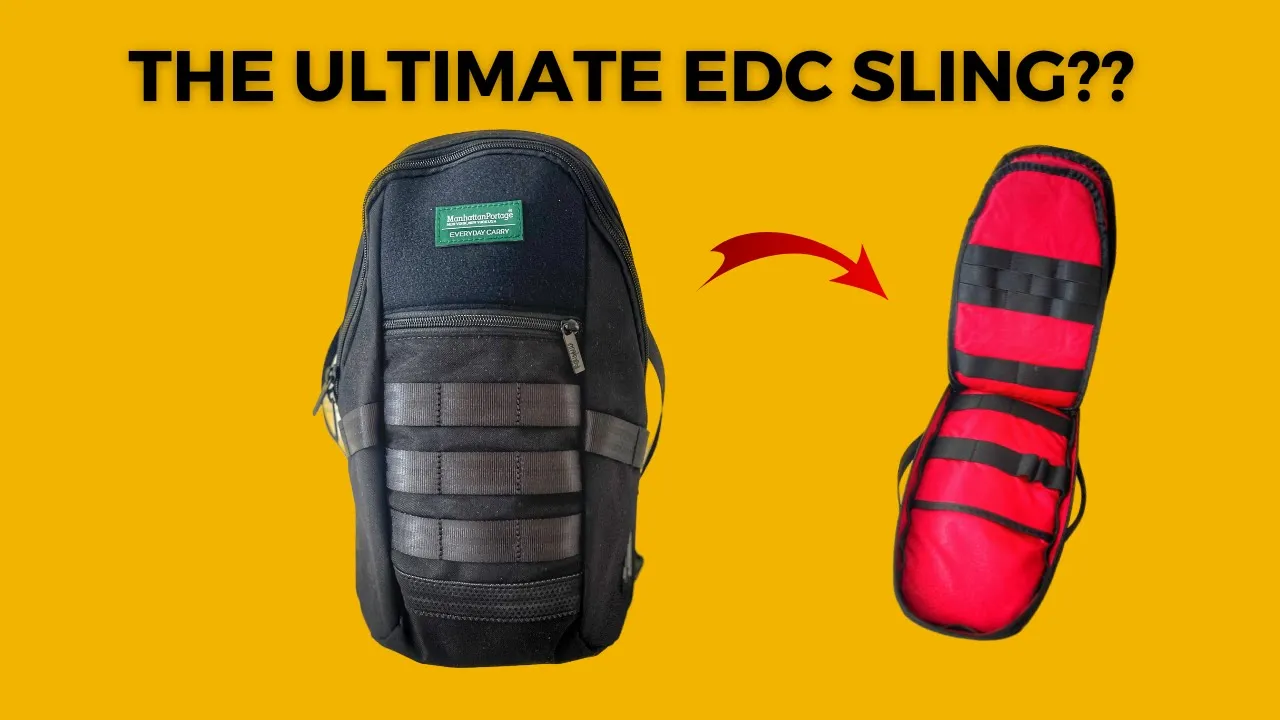
Coverage from seeding product sample to an influential creator in the bag community.
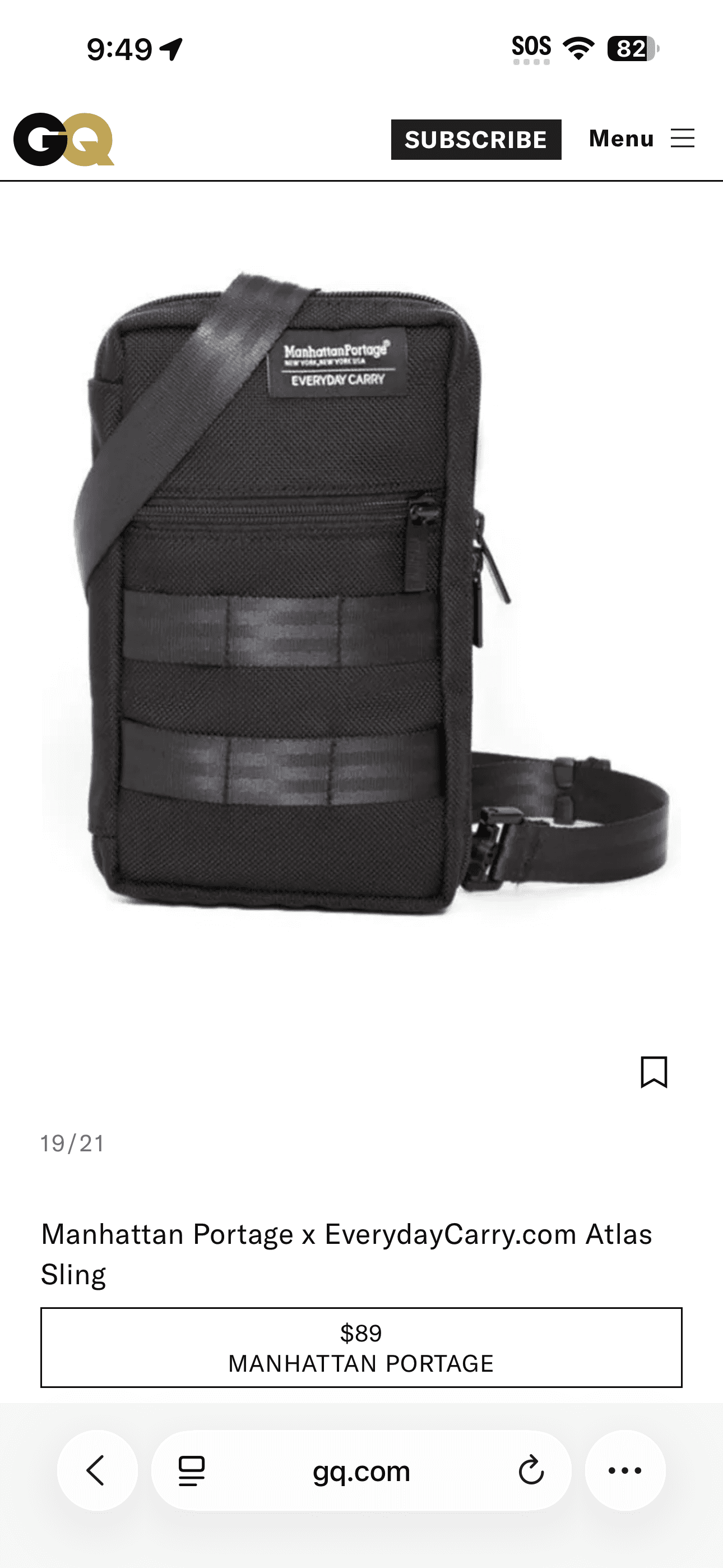
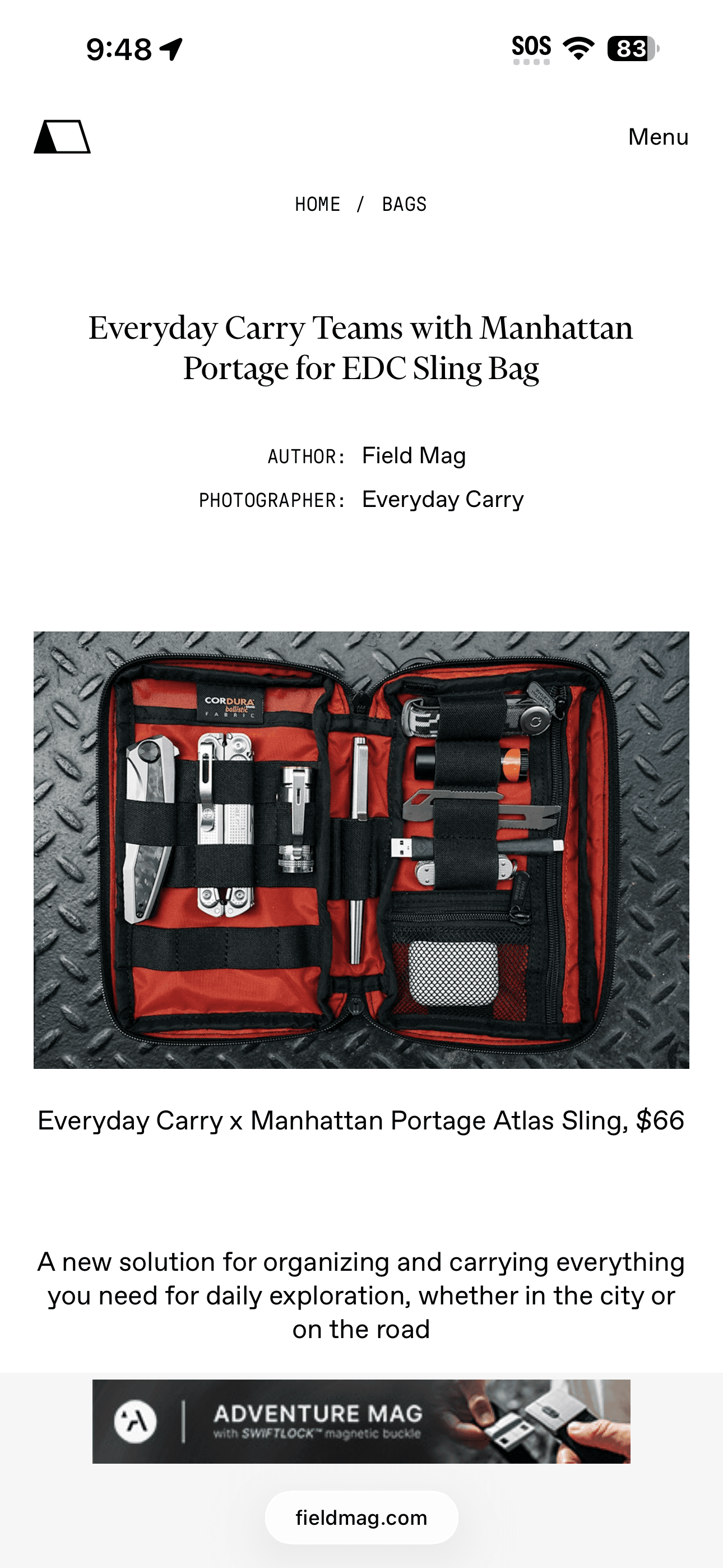
Editorial press hits from fashion publications. GQ "20 Best New Menswear Items" (Oct 2019), Field Mag (2019).
Launch Emails
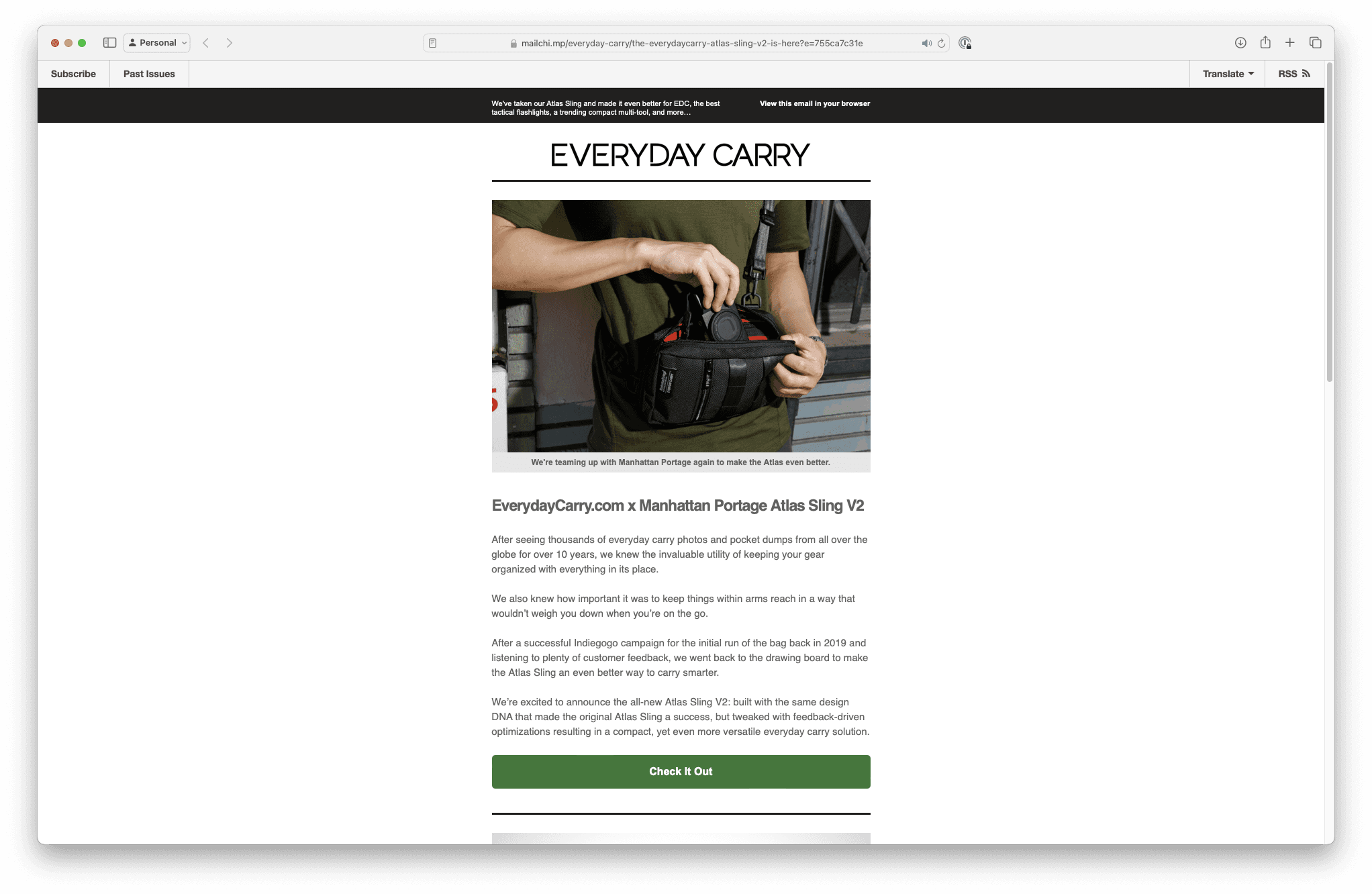
V2 launch newsletter email
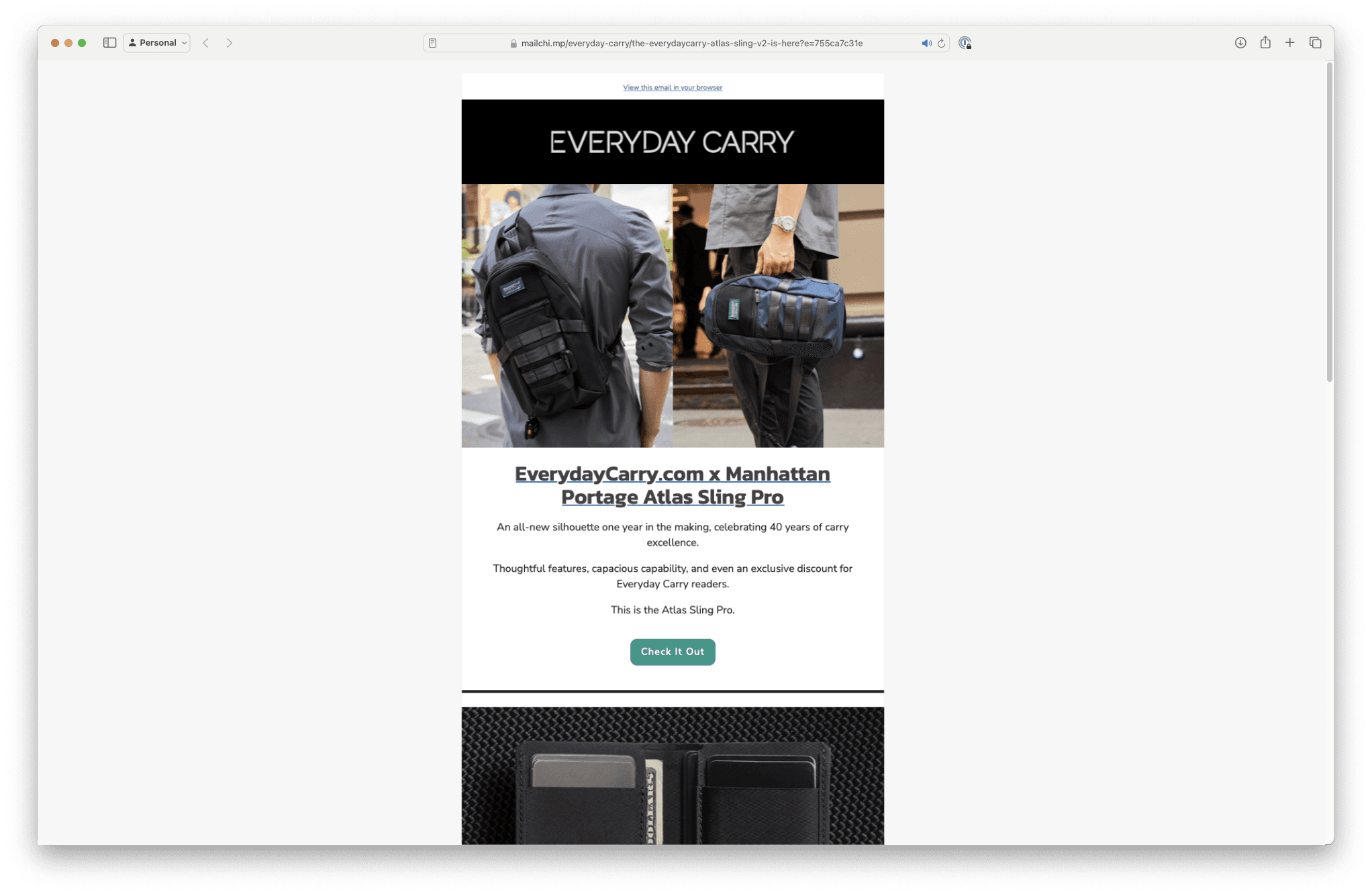
Pro launch newsletter email with exclusive reader discount for sales enablement
Content Operations
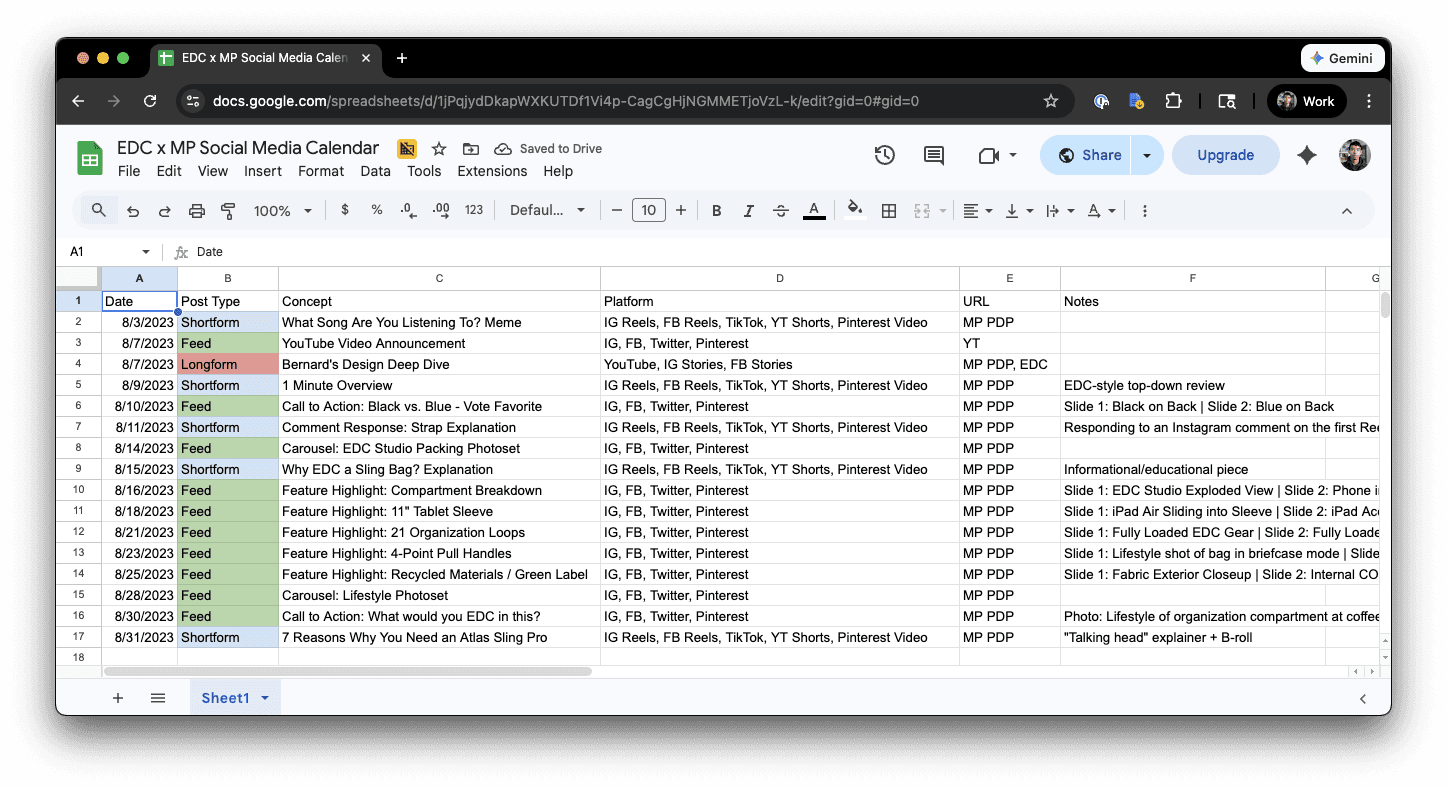
Shared content calendar with Manhattan Portage: 16 posts across 5 platforms in August
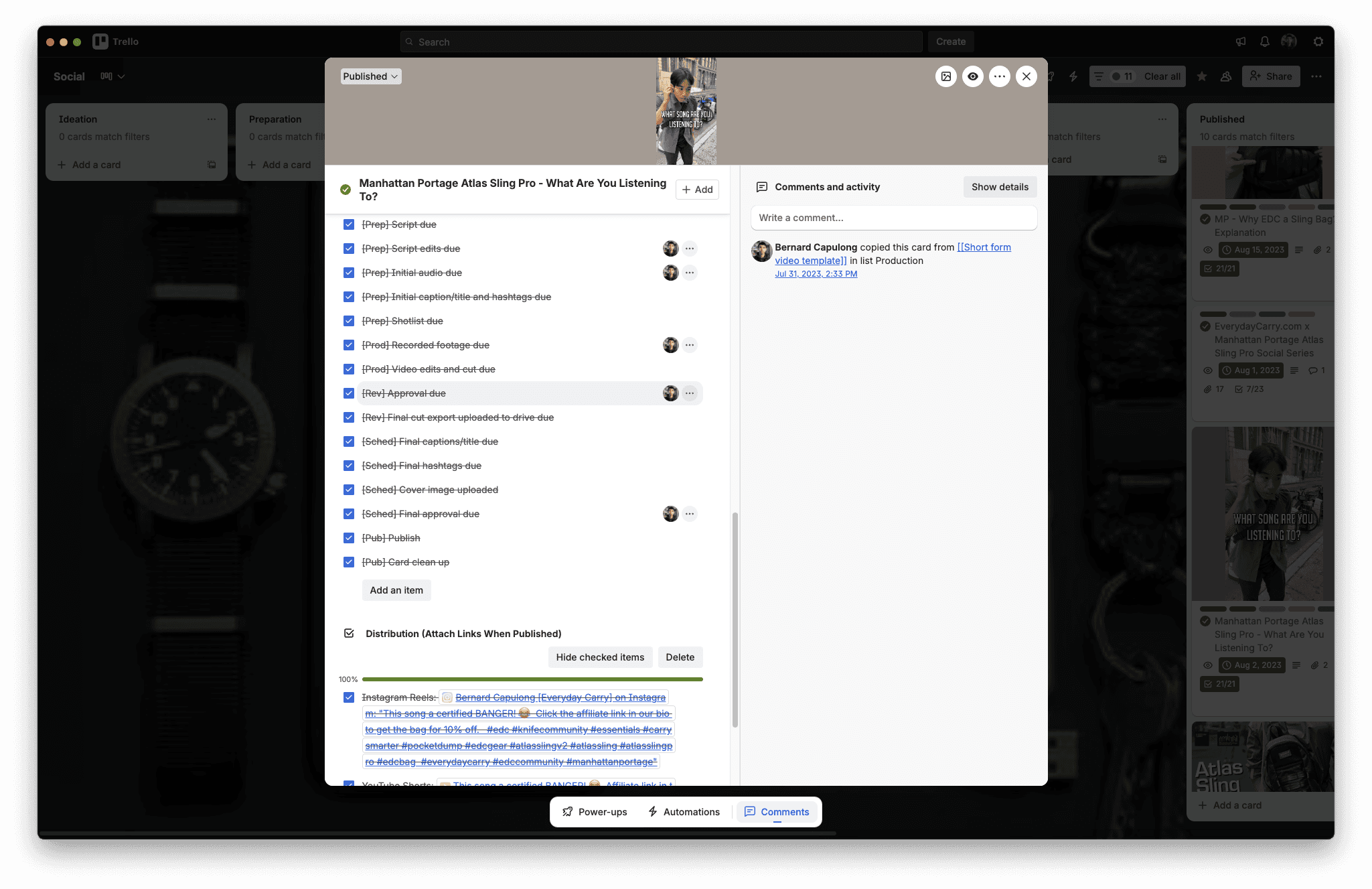
Trello workflow: full production pipeline and distribution checks
PDPs and Copy
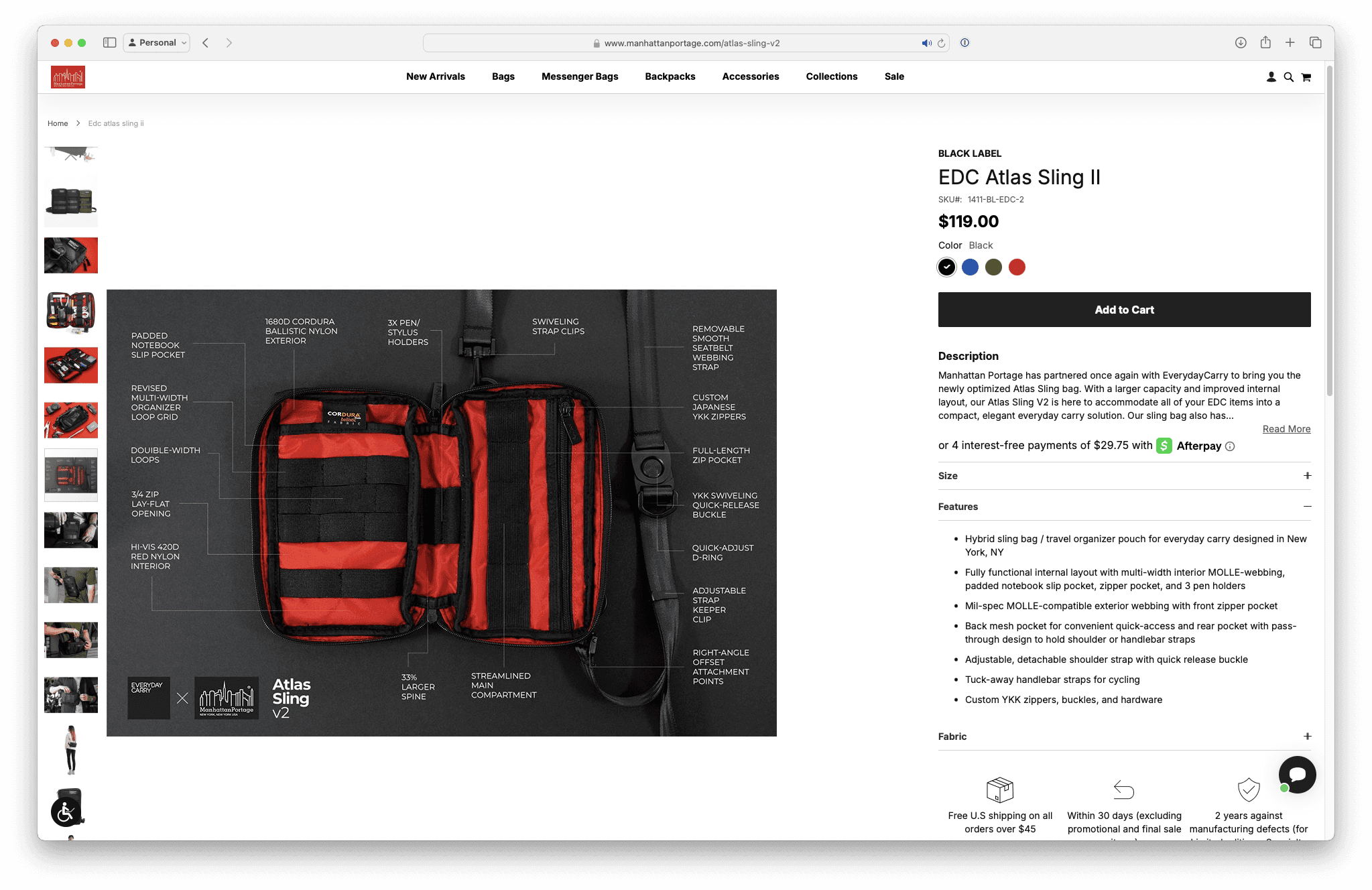
V2 Product Page with in-house imagery and feature-to-benefits copy translation
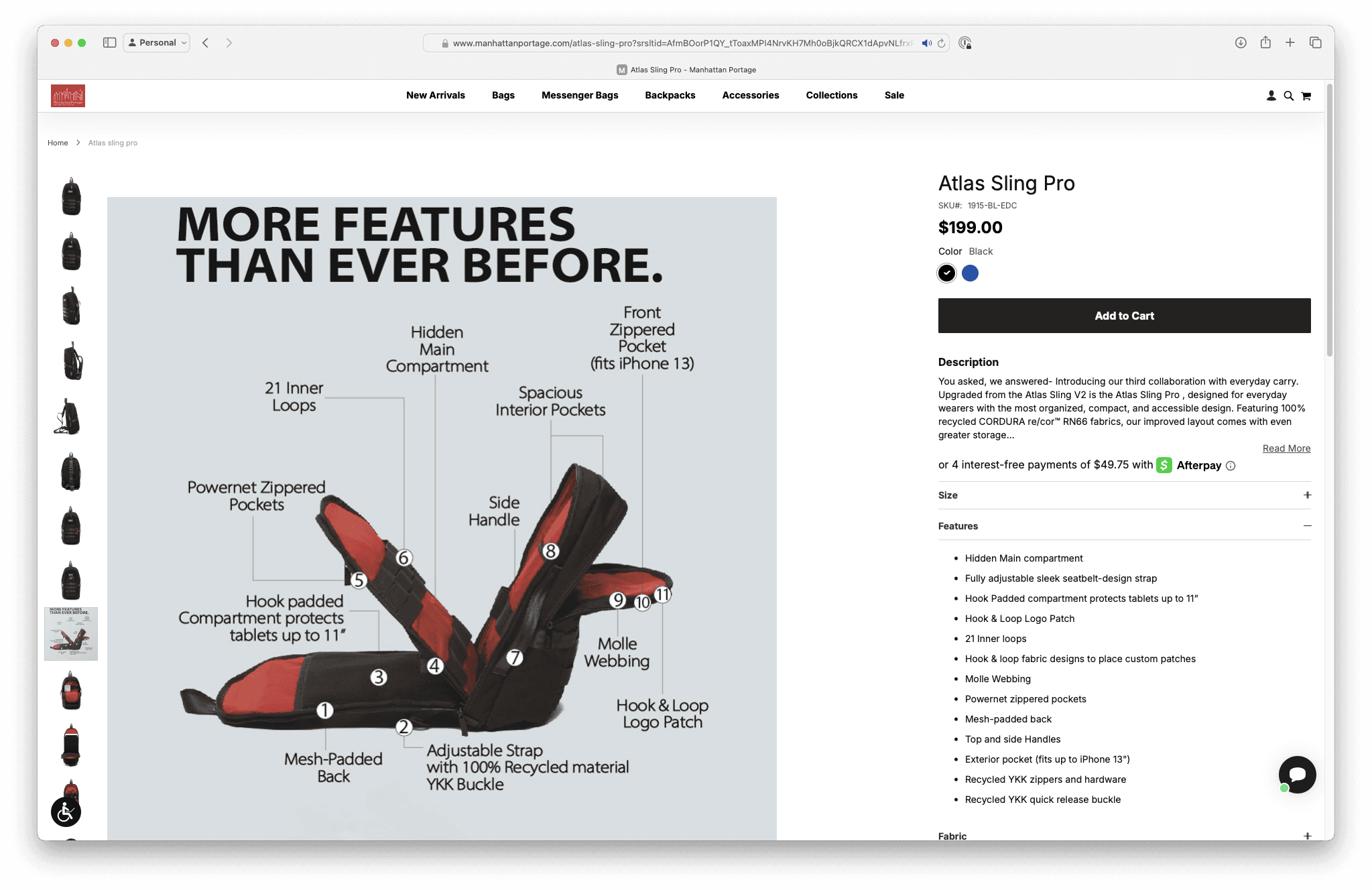
Pro product page with infographics iterated upon learnings from previous V1 and V2.
Notes
YouTube and TikTok metrics are from owned analytics captures. V2 sell-through figures are based on MP internal communication.
Pro sales figures are not public. Partnership durability (5 years, 3 silhouettes, both SKUs in stock) is the primary result indicator.
Press placements are independent editorial. No sponsored content.