Arc'teryx Veilance: Sales Enablement & Product Knowledge
How I developed product knowledge training and sales enablement materials for the first standalone Veilance boutique, translating complex technical specifications into sales narratives for associates nationwide.
Category
Sales Enablement & Product Knowledge
Disciplines
Sales Enablement, Customer Research, Product Knowledge Training, Buyer Personas, Competitive Analysis
Client
Arc'teryx Equipment
Year
2016 - 2017
Context
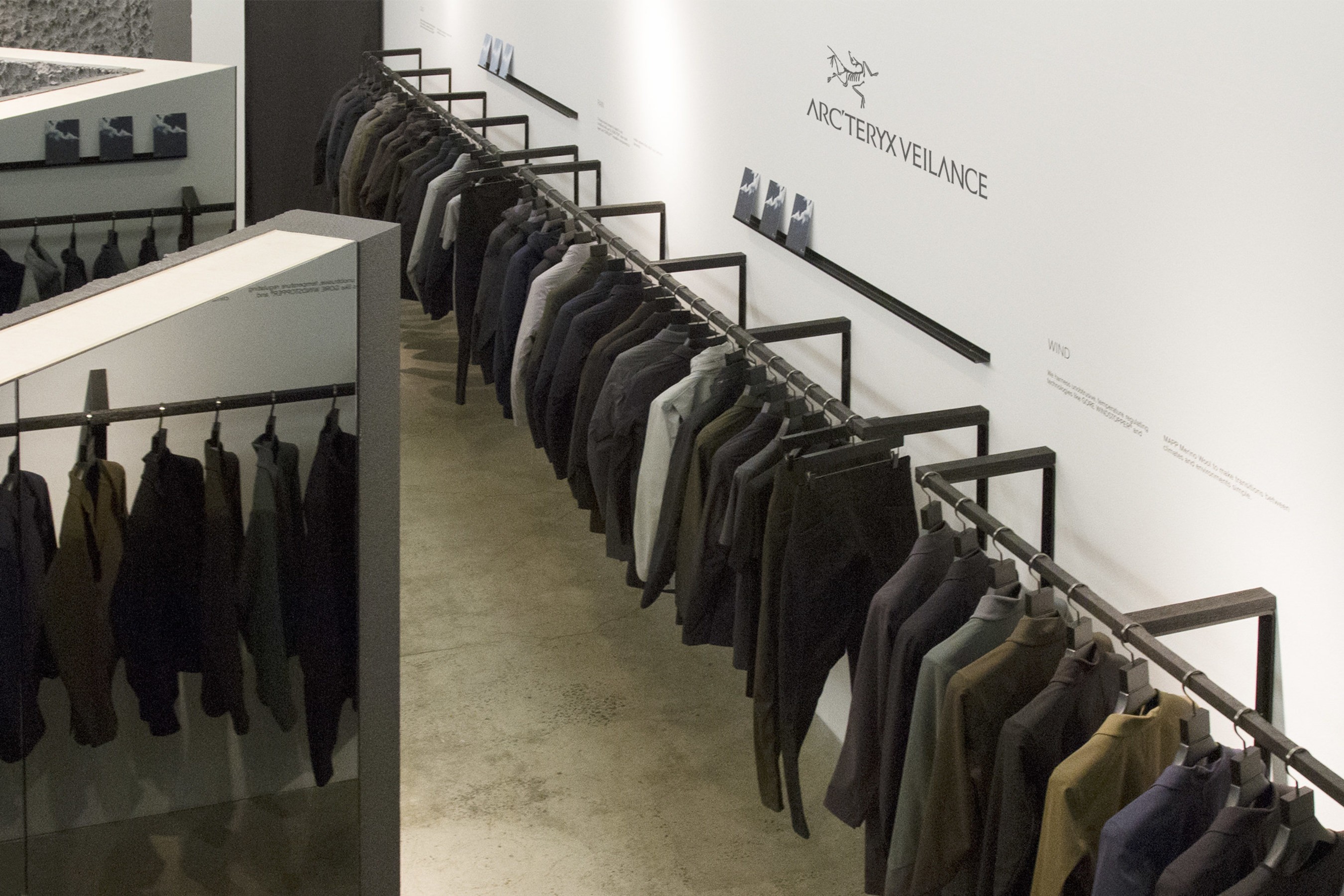
Long before the recent “gorpcore” trend, Arc’teryx had already established itself as a top-tier outdoor brand through its strong offering of high-performance technical garments. Hidden in plain sight among those offerings, though, was Arc’teryx Veilance: its minimalist fashion collection made with even more advanced technology and design language than the mainline bearing the prominent “dead bird” logo. Despite Arc’teryx Veilance launching in 2009, it hadn’t had breakout success. When I walked into the Arc’teryx SoHo store in New York City in 2016, I saw it firsthand. Nobody was buying.
I came into the store with a group of friends and walked them through the latest collection. I subjected them to my excitement and showed them how the garments used microstitching and tape at the seams to improve water resistance by minimizing points of water ingress, how their flagship raincoat’s zipper construction differed from their GORE-TEX ski jackets, and how different pieces came together for coherent looks depending on the weather.
This was normal window shopping for me. I had grown up on internet fashion forums and was already years into reviewing premium, utilitarian products through my company, Everyday Carry. One of my online friends from Vancouver grew up to work as a designer at Arc’teryx and eventually designed Veilance. Through him I got introduced to the brand. Naturally, I wanted to support his work, but it ended up resonating with me so much it became my favorite clothing brand. The powerfully subtle design language,emphasis on functionality, and modularity tickled my brain in the same way EDC gear did.
The store manager took notice. Instead of asking me if I had any questions about the new collection, she had a question for me: “Would you like to work for us?” I already looked the part. I was dressed head to toe in Veilance and practically making a sale to my friends in the corner of the store the actual employees neglected.
Later that year, I was brought on as a founding member of the first standalone Veilance boutique. It was a go-to-market initiative to drive awareness to the general public, featuring exclusively Veilance products and thematic art installations situated in a prime location on the cobblestone streets of SoHo. But the area wasn’t without competition: there was no shortage of Fall/Winter collections from luxury brands that fashion-forward shoppers actually knew and recognized. Arc'teryx needed its retail teams to sell Veilance confidently, but the very things that made the products special were what made them a tough sell. They were expensive ($1,500 for a coat), technologically advanced, and sitting in a crowded luxury space with no brand recognition to lean on.
There was no unified training resource that gave associates the brand story, the product knowledge, the competitive context, and the sales tactics they needed in one place. I built it.
The Challenge
Enabling retail associates to sell a $1,500 technical garment meant overcoming a specific set of problems. Customers didn't understand why it was better than a Canada Goose parka, or more expensive than mainline Arc'teryx even though it didn't have a logo on it. For some customers, flexing the logo was the whole point of purchasing.
Three things made this hard. First, Veilance's value proposition was purposefully quiet. The brand's design philosophy was "the invisible advantage": peak performance hidden in plain sight, no visible branding, neutral colors. That's a tough story to tell at the point of sale.
Second, the product specs were written for engineers, not customers. GORE C-Knit Technology. Down Contour Construction. TerraTex. These meant nothing to a shopper unless someone translated them into benefits they could feel.
Third, associates were fielding real objections: "It's too expensive." "Is it waterproof?" "Why not just buy a Moncler?" And there was no playbook for handling them consistently across locations.
Strategy
I built a comprehensive training deck deployed to retail locations nationwide. The deck was structured as a deliberate learning sequence (each section building on the last) and it covered brand positioning, product translation, competitive intelligence, and sales enablement.
1. Establishing the Brand Story First
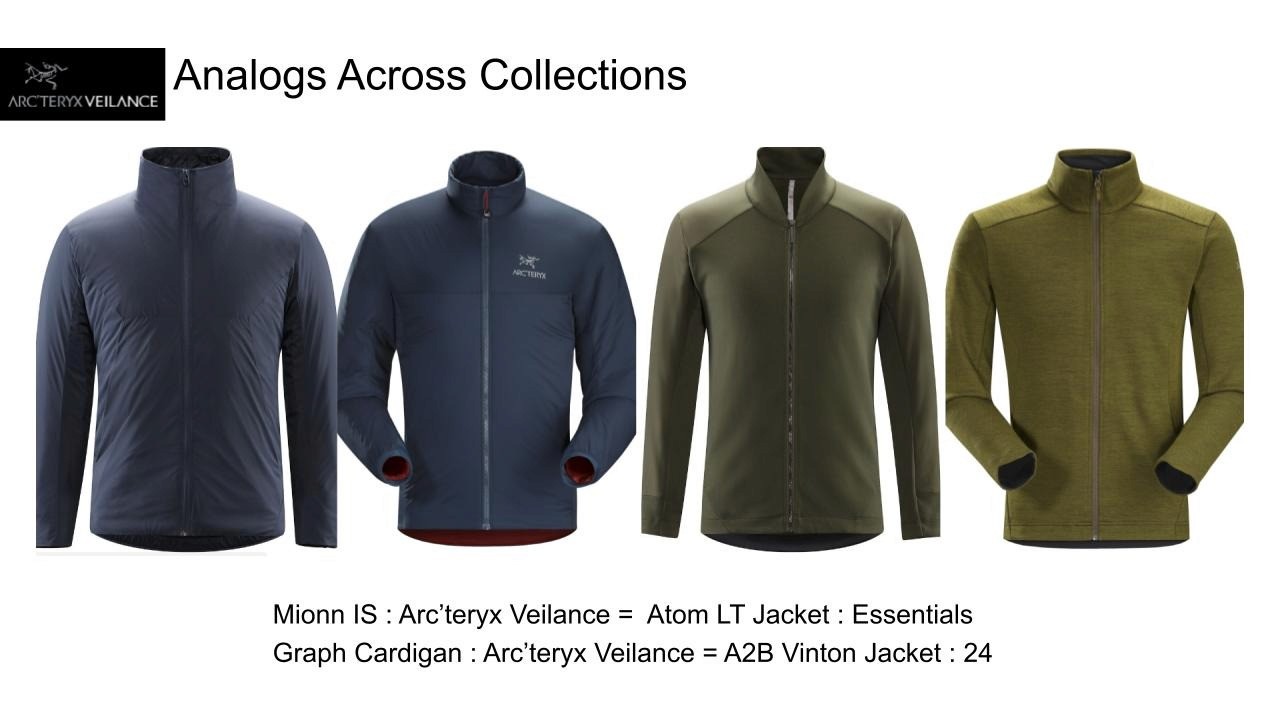
Before getting into product details, I grounded associates in what Veilance actually is. The deck opened with the brand's relationship to mainline Arc'teryx (shared values like obsessive perfectionism and use of the best materials) then introduced Veilance's distinct identity: classic menswear inspiration executed with modern technical performance. The core principle was what I called "The Invisible Advantage": Veilance stands out precisely by blending in.
2. Defining Who Buys Veilance
I identified five distinct buyer segments based on what I was observing on the retail floor and what drove purchase decisions in practice:
Buyer Segment | What They Care About |
High-income professionals | Quality, discretion, wardrobe versatility |
Business travelers | Packability, wrinkle-resistance, weather protection |
Menswear enthusiasts | Tailoring, design details, brand credibility |
Techwear enthusiasts | Technical specs, material innovation, functional details |
Brand loyalists | Arc'teryx heritage, craftsmanship, the broader ecosystem |
3. Translating Specs into Benefits
I took the technical specifications from the product sheets and turned each one into a customer-facing benefit, the kind of language that closes a sale.
GORE C-Knit Technology | Comfort—no swish, no crunch when you move |
Down Contour Construction | Serious warmth without bulk—trim silhouette |
Coreloft Compact | Packs small enough for a carry-on |
TerraTex (94/6 Nylon/Elastane) | Barely-there feel, surprisingly strong |
Beyond the spec-to-benefit translation, I also built a "Devil's in the Details" section that walked associates through the hidden design elements of each garment (the hardware, the seam placement, the pocket construction) so they could point to specifics when a customer picked something up. The idea: once you see the craftsmanship up close, the price makes sense.
4. Competitive Intelligence
I researched and mapped three direct competitors, giving associates the context they'd need when customers inevitably brought them up:
ACRONYM | Closest competitor in fashion + function. ACRONYM leans futuristic/visible. Veilance’s edge: understated, wearable, versatile. |
Moncler | Luxury-first, fashion-forward. Veilance’s edge: higher technical performance, more humane sourcing, better weather protection. |
Canada Goose | Celebrity-driven, status-focused. Veilance’s edge: humane goose down (vs. duck), significantly better technical performance, subtler aesthetic. |
5. Objection Handling Playbook
I built a structured playbook for the six most common customer objections I'd encountered on the floor. Each one included a concrete response strategy (not a script) but a framework for how to reframe the conversation.
Objection | Reframe |
It's too expensive | Reframe as an investment. Lifetime warranty. Protects other investments (suits, travel gear). |
Poor fit | Acknowledge the feedback. Recommend sizing up, or styles with stretch or roomier silhouettes. |
Not waterproof | Explain the Rain-Wind-Cold layering system. Windstopper + taped seams = effectively water-resistant. |
No women's line | Pieces are unisex. Sizes go down to XS. Highlight the most flattering silhouettes. |
Moderate climate | Steer toward lighter insulating layers + shell combos. Frame it as microclimate control, not winter warmth. |
6. Sales Tactics Grounded in the Customer's Experience
By the end of the deck, I'd shifted away from deep product knowledge to more frameworks about how to talk to customers. I had closed enough sales to come up with a fairly comprehensive framework that aligns with how I market any product.
First, I'd simply ask what they're looking for and why. It might sound like me simply asking what they need, but the key is to read between the lines of what the customer is saying versus what they're actually describing. For example, they might say they just need a raincoat for the cold season, but they have a favorite jacket already that's perfectly warm, just not waterproof. So they say they can't justify the price of this integrated, waterproof down jacket. The customer doesn't realize they're considering the wrong product, and there are other standalone, uninsulated rain jackets that layer perfectly over the coat they're wearing at a fraction of the price of the jacket they've been eyeing.
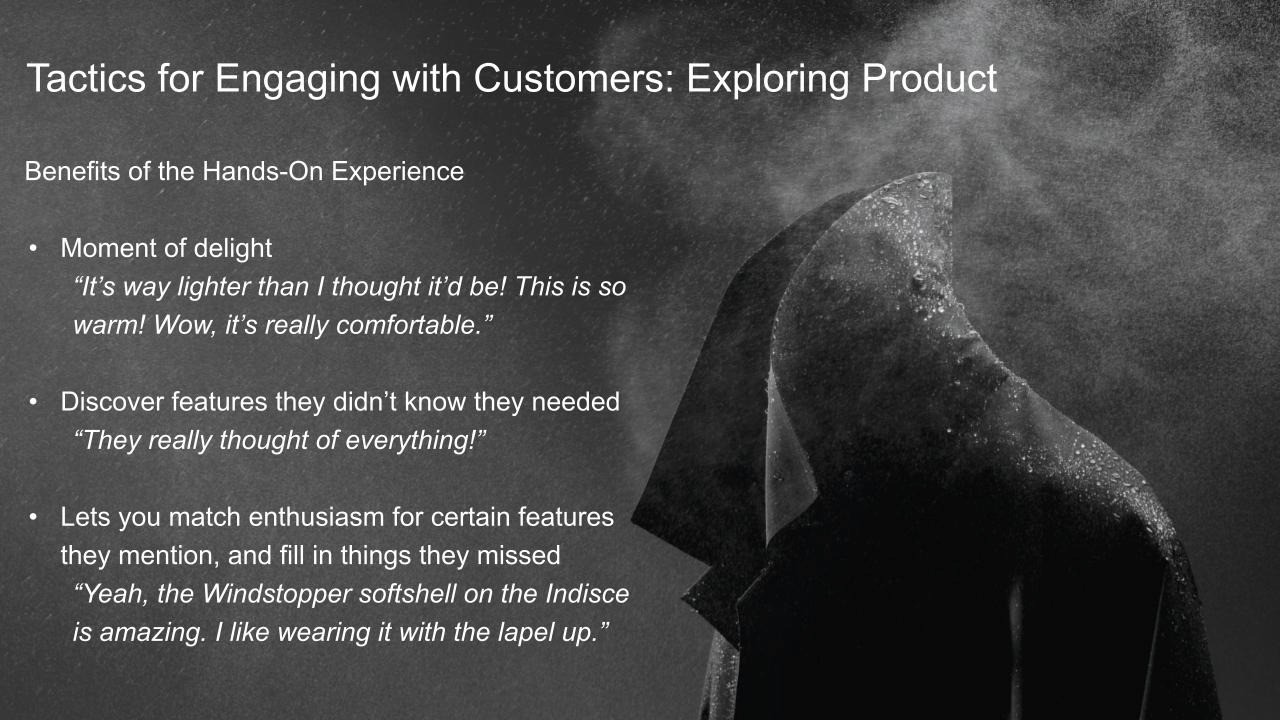
Next, I'd invite them to try it on and carefully watch how they interact with the jacket. Do they discover the hidden pockets? Do they notice how smooth the center zipper feels? If they miss certain features, I'd gently point them out, and suddenly the customer not only understands the product better, they start to live the experience of actually owning it. It starts to make sense.
If they point out something they notice and enjoy about the garment, I could echo the sentiment: "Yeah, I actually own that jacket and layer it the same way you did." It built social proof from a place of authenticity and established a connection.
By the end of the interaction, the customer understood not only the product, but their true needs and use case better than before they came into it. They've had hands-on experience with the product and understood enough to feel confident in making a justifiable purchase.
Results
The training deck was deployed to Arc’teryx retail locations nationwide. Associates selling Veilance now had a unified resource: brand positioning, product knowledge, competitive context, and objection-handling frameworks. Conversations between newly trained associates and customers brought a newfound clarity. The invisible advantage was coming to light.
This project became one of the earliest examples of a pattern I’d keep returning to: building internal documentation that translates product details into customer value. At Veilance, I had existing products, customer interaction data, and months of retail floor conversations to draw from. It was a slightly different scenario later in my career at Ridge: I was working with brand new products, no customer data yet, and a team that needed confidence before day one. I originally built a product knowledge initiative to train and empower our marketers, but I wasn’t dealing with a small seasonal collection in a singular retail store at Ridge. To handle new categories, international markets, and both brick-and-mortar and digital channels, I built stronger infrastructure at the process level.
I didn’t walk into the store that day trying to convince my friends to buy the same clothes as me. I just wanted people to share my enthusiasm and I thought the best way to get there was by a shared understanding. That approach is what I brought to the retail floor later on as an associate on the boutique’s founding team. It’s the foundation of the why and the how of my work throughout my career.