EverydayCarry.com: Community-Driven Product Discovery System
How I designed a five-stage product discovery and distribution system that turned community-generated content into a scalable engine for audience growth and affiliate revenue at EverydayCarry.com.
Category
Product Discovery & Distribution
Disciplines
Audience Development, Community Marketing, Distribution Systems, Affiliate Marketing, Growth Strategy
Client
EverydayCarry.com
Year
2024 - 2025
Context
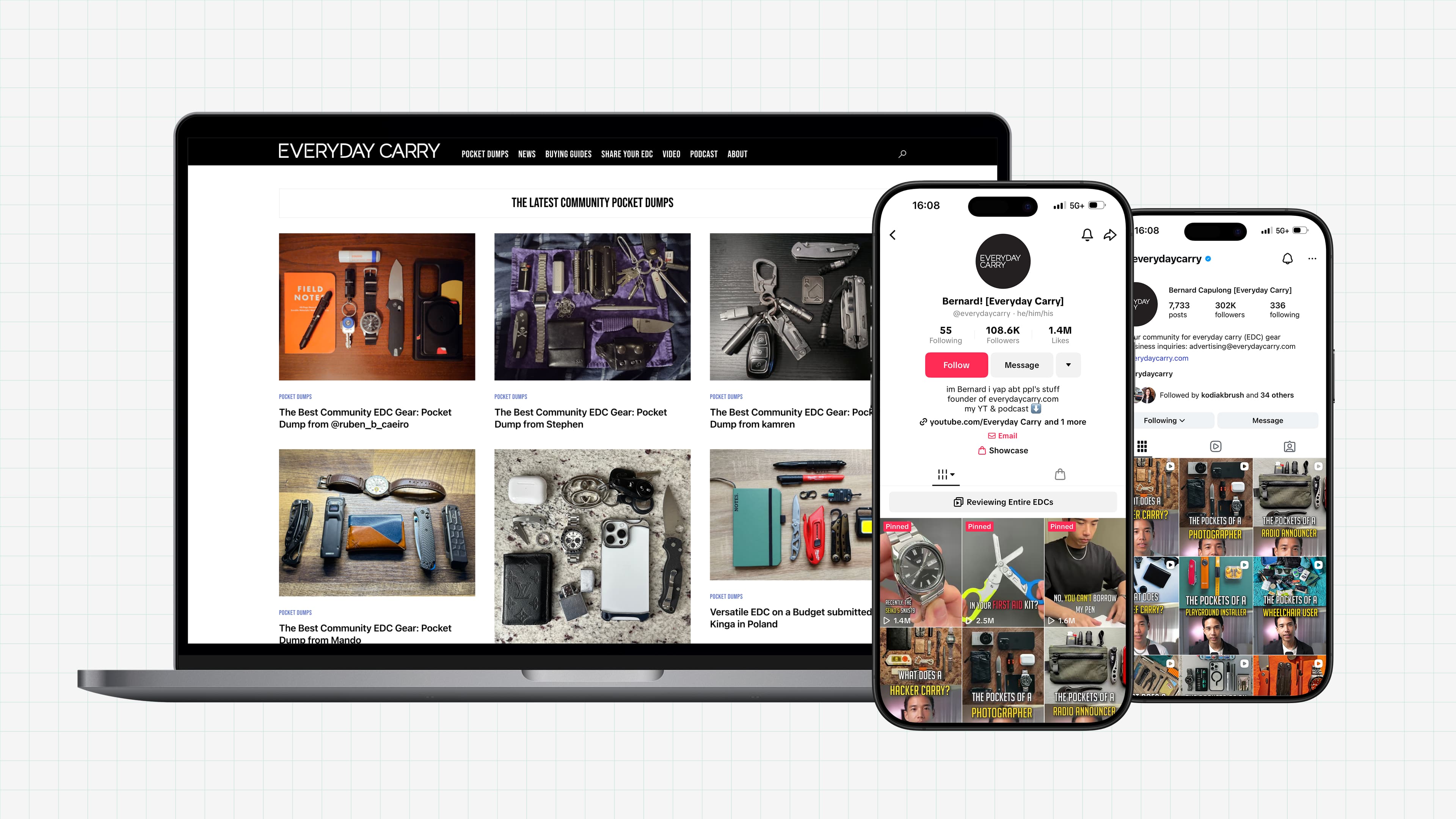
I founded Everyday Carry in 2009 as a way to share my passion with the rest of the world. Through my own product research for essential tools I needed every day, I discovered thriving communities with deep knowledge about these everyday essentials, but they were fractured across various discussion forums with the good stuff buried deep in 50-page long threads. I loved what I saw inside of these walled gardens but couldn't help but think all the wisdom around using the right tools for the job and relying on the best products every day would help way more people if they could actually find it.
I spent over 15 years breaking down these walls brick by brick, curating the best products, highlighting shining examples of good EDC, demystifying complex enthusiast knowledge, and cultivating a welcoming community for a global audience.
The platform grew to 380K monthly visitors and a 1M+ multichannel audience through my commitment to building and empowering the community through UGC, authenticity through honest reviews and carefully selected partnerships, and a stance on polarizing content that favored accessibility and inclusion.
Every phase of that growth was instrumented. I tracked what articles people read, what products they bought, what brands they actually use, how much money they were spending and where. Each click taught me about my audience, my own content, where the category was heading and what I needed to keep up. I modeled my business like any gear worth carrying: tastefully designed, durable in harsh conditions, utility-led and performance-driven. I paid close attention to what the numbers told me and treated online content like an art and a science.
The Problem
Through the years, the landscape of that content changed drastically, and I adapted the business with the times. When SEO-driven buying guides became the most valuable content for readers and for the business, I built that engine and climbed the ranks. But eventually, people stopped reading blogs and preferred finding their content via algorithmic feeds on social media. So I adapted again, this time in front of the camera with an influencer-style content strategy, bringing the same "nerdy friend who you can ask for a super specific recommendation" energy I've always had in my writing. Each phase was a pivot in lockstep with evolutions in technology and reader behavior, each time meeting my audience where they were with the content that resonated best.
When I started, my site was the first to really cover the EDC category. Naturally, I had no competition. But by now, even major publications were getting in on EDC's growing popularity. The influencer business model was democratized and anyone with a smartphone was competing for attention. So many factors that were out of my control started to have a bigger and bigger impact: unpredictable changes in algorithms leading to the enshittification of the Internet, erosion of audience trust thanks to the proliferation of AI slop, influencer fatigue caused by people who really weren't in it for the love of the game just trying to make a quick buck.
I was getting frustrated with adopting the strategies du jour just because everyone else was doing them. And honestly, it was for that exact reason that those strategies stopped working: a tragedy of the commons. When people say "things were better before," sometimes it's true. And in my case, I was watching the content landscape come full circle. People didn't trust my opinions as a solo "blogger" and wanted the credibility of a "real company." So I built a whole dotcom organization, and it wasn't long until people couldn't trust these so-called SEO content farms and wanted a real opinion from a real person. So I stepped in front of the camera once again. Except this time, I was just another influencer on their For You page.
Every conventional strategy I'd executed well was now unreliable, and the audience's craving for authenticity only grew louder. But I'd been building something authentic since 2009. The community trust, the editorial voice grounded in genuine product knowledge, the audience that came to EDC because they believed what they found there was real. None of that depended on an algorithm or a content trend. And I had over 15 years of operational discipline telling me exactly how that foundation translated into business results.
This case study is about what happened when I stopped chasing the meta, remembered my roots, and leaned into building real infrastructure around what made this project special from day one.
The Insight
In times like these, my community-submitted UGC was the answer that had always been there. A real photo of real products used by a real person, proven with every scuff and scratch, contextualized as a coherent system, organized neatly with reverence and aesthetic appeal. It’s undoubtedly the strongest product recommendation I can offer, and it’s what none of my competitors had. Not at this scale. Not with this credibility. As an influencer, I didn’t need to defend my opinions or earn the viewer’s trust. By highlighting UGC, I was simply the messenger, sharing someone else’s story, insights, and recommendations for everyone to learn from and enjoy.
I had been overlooking how much potential the raw material had while I was banging my head against the wall trying to make the popular strategies work. I was pouring time and resources into writing these well-researched, beautifully produced buying guides to outrank my competition, not because the audience asked for them, let alone even trusted them at that point.
Meanwhile, I was treating UGC as a volume play for easy, last-click attribution in an affiliate model without really giving it the editorial support it needed to deliver its true value. But if I freed up some resources by no longer overinvesting in the buying guide format that audiences were actively devaluing anyway, I could give UGC the editorial love it needed to make impact without sacrificing volume either. I had all the pieces, I just needed to build the engine.
The System
I designed the system around five workstreams: acquisition, curation, merchandising, distribution, and the feedback loop.
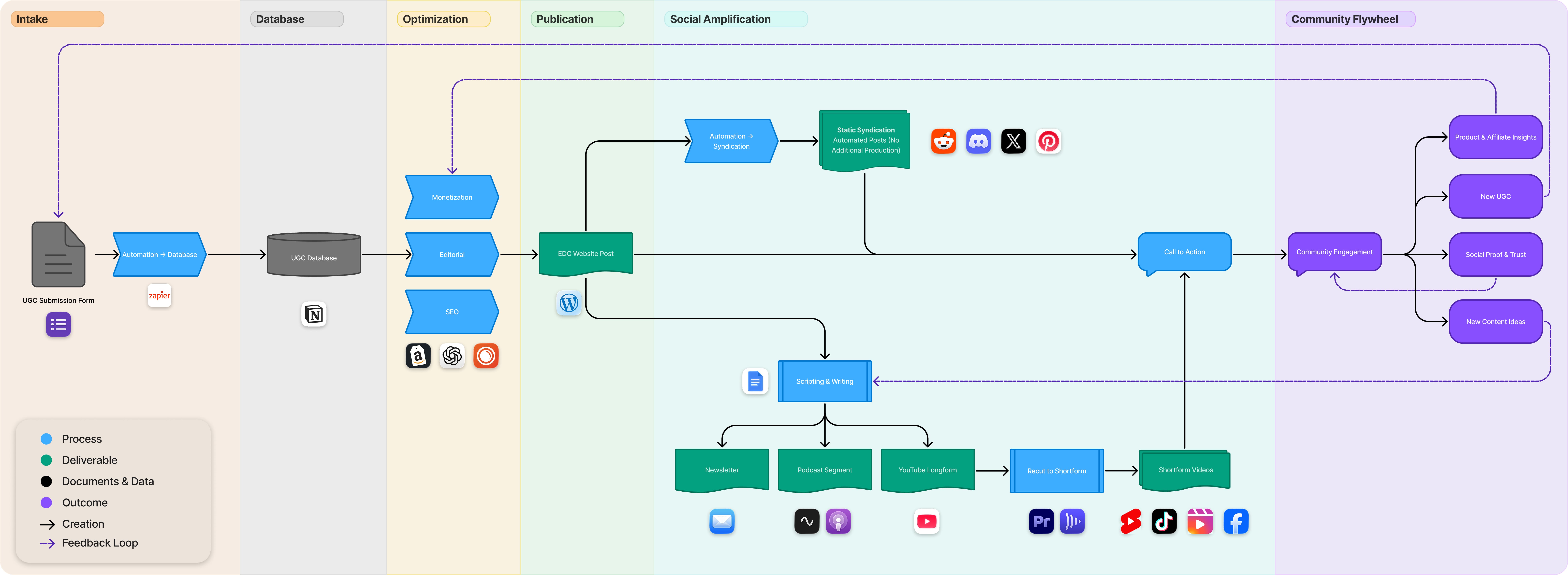
1. Acquisition: Building the Intake Pipeline
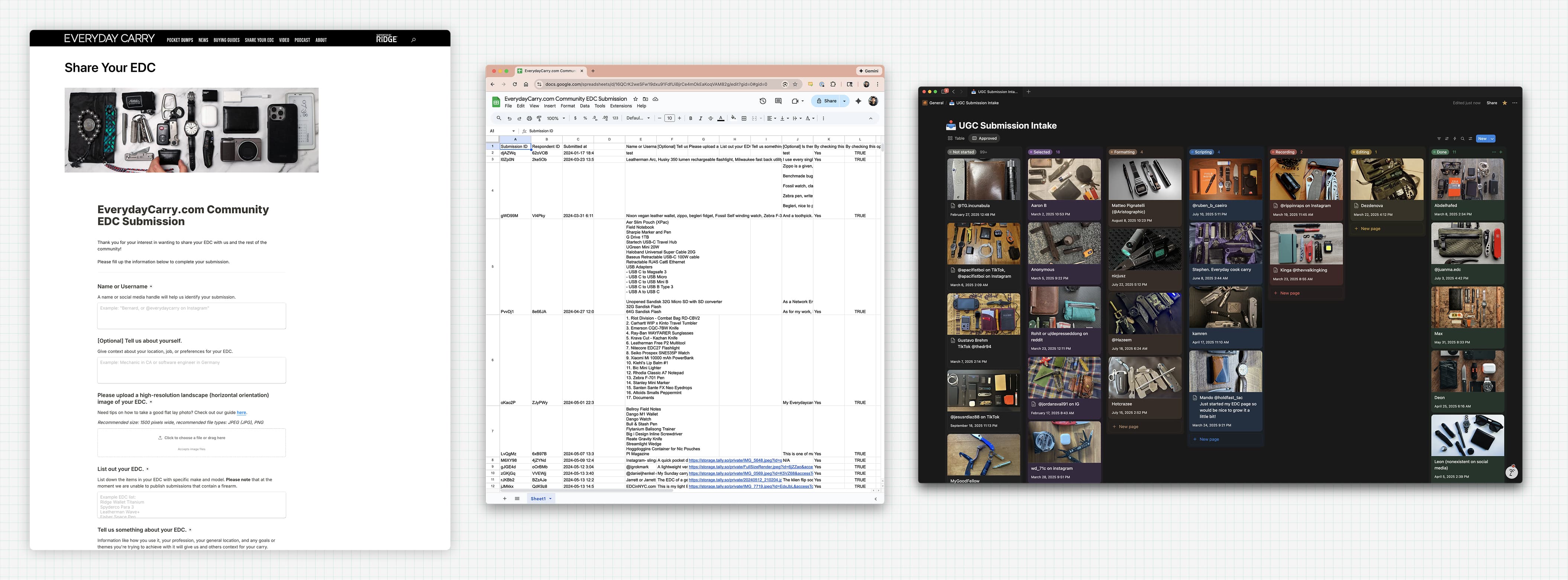
I built a submission form pinned in the site navigation and linked as the primary CTA at the end of every piece of content. The form captured what mattered for product discovery: the submitter's name, profession, location, and a detailed item list with specific makes and models. Submissions routed automatically into a Notion database, giving me a structured pipeline to work from.
The profession field was the key design choice here. It gives every submission an instant context frame ("This is what a network engineer carries") that makes the product choices meaningful to a specific audience.
2. Curation: The Editorial Gatekeeping Layer
The Notion board tracked submissions through stages: from intake through selection, formatting, scripting, recording, editing, and publish. At any given time, there were 99+ submissions waiting and only a handful moving through the pipeline. The selection rate was low, and deliberately so.
I selected submissions based on three criteria: photo quality (visual clarity for the format), product selection (interesting, diverse, story-worthy gear), and narrative strength (does this person's carry tell a compelling story about how they live and work?). Those choices determined what products got featured, to what audience, and in what context.
3. Merchandising: Turning Features into Conversion
Once a submission was selected, I editorialized it into a product discovery piece with real conversion architecture. Each item got a trackable affiliate link (tagged edcugc-20 in Amazon Associates, giving me clean attribution on every click). Then I selected a single "top pick" (one item from the carry that deserved a deeper spotlight) and built a dedicated product highlight around it with a buy button, current price, and a short editorial note on why it stood out.
Choosing the top pick meant understanding what would resonate with the audience, what had good conversion economics, and what told the right product story in context.
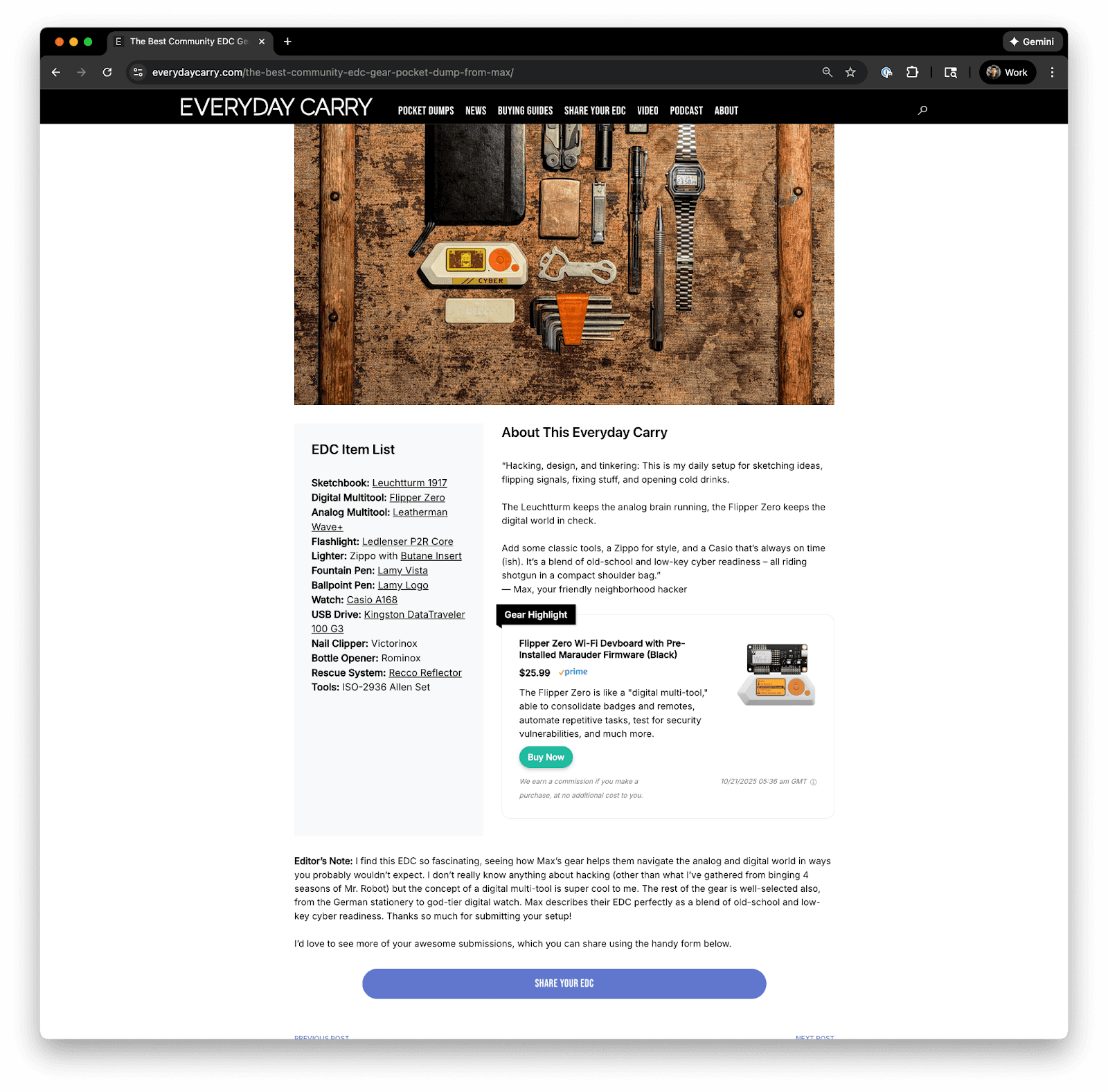
4. Distribution: Platform-Native Channel Strategy
A single submission became 10+ content outputs: a monetized site post, vertical shortform video for TikTok and Reels, a YouTube roundup segment, a podcast episode, and syndication to image-based platforms like Pinterest and Reddit. Each format was adapted to how that platform's audience actually consumes content, not just repurposed.
The shortform script followed a tested structure: a hook built around the profession ("This is what a network engineer carries"), an item-by-item breakdown with my editorial opinions to drive engagement and product education, and an outro CTA that linked back to the submission form and the product links.
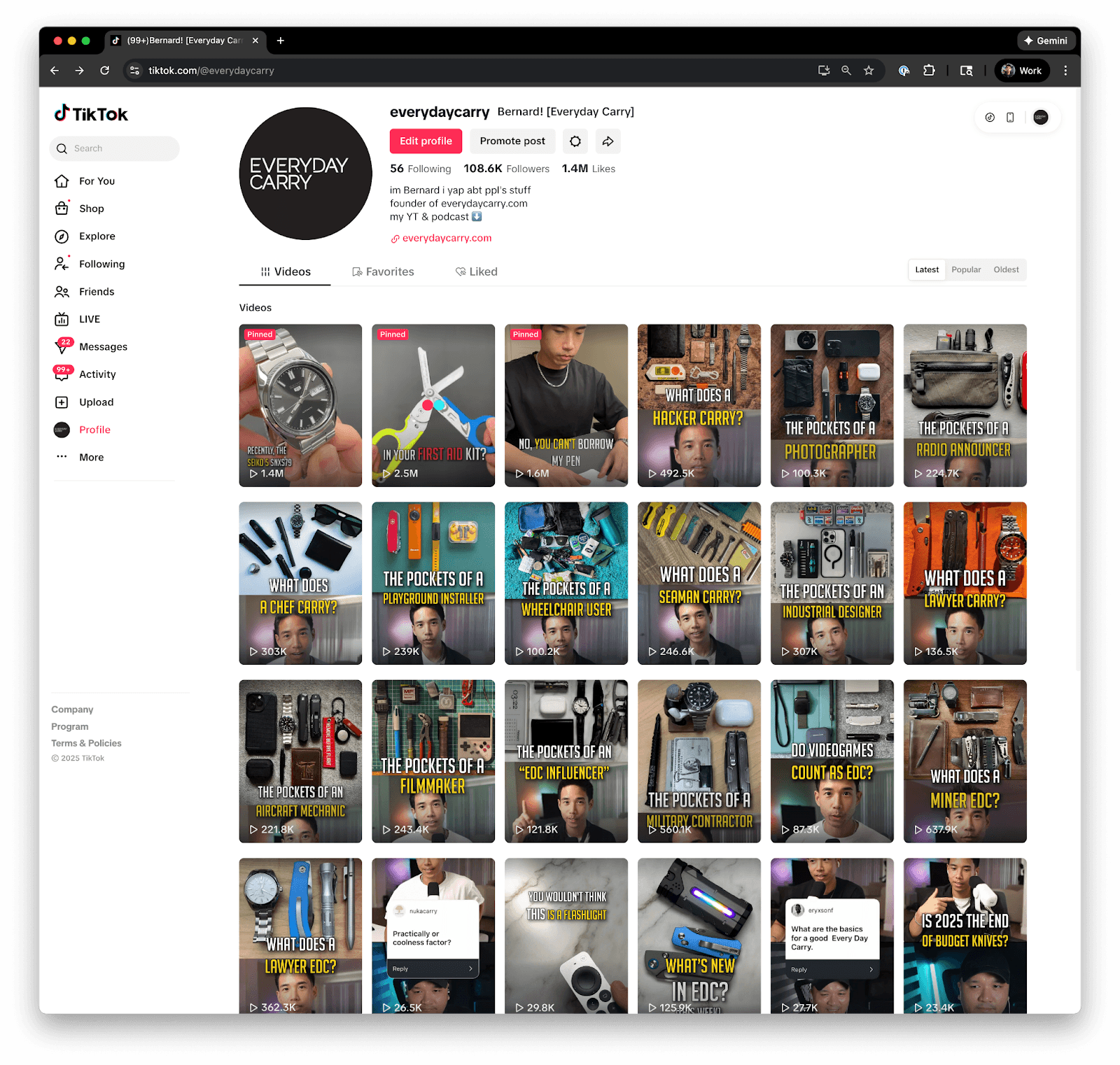
5. Feedback Loop: Community as a Signal Source
Ending every piece of content with a clear CTA to submit your own carry did two things. It continuously replenished the top of the acquisition funnel. The system was self-sustaining. But it also generated signal. The comments and engagement on each piece told me which professions resonated, which product categories drove the most interest, and which story formats kept people watching.
That fed directly back into future curation and merchandising decisions. The community wasn't just watching. They were telling me what to make next.
Results
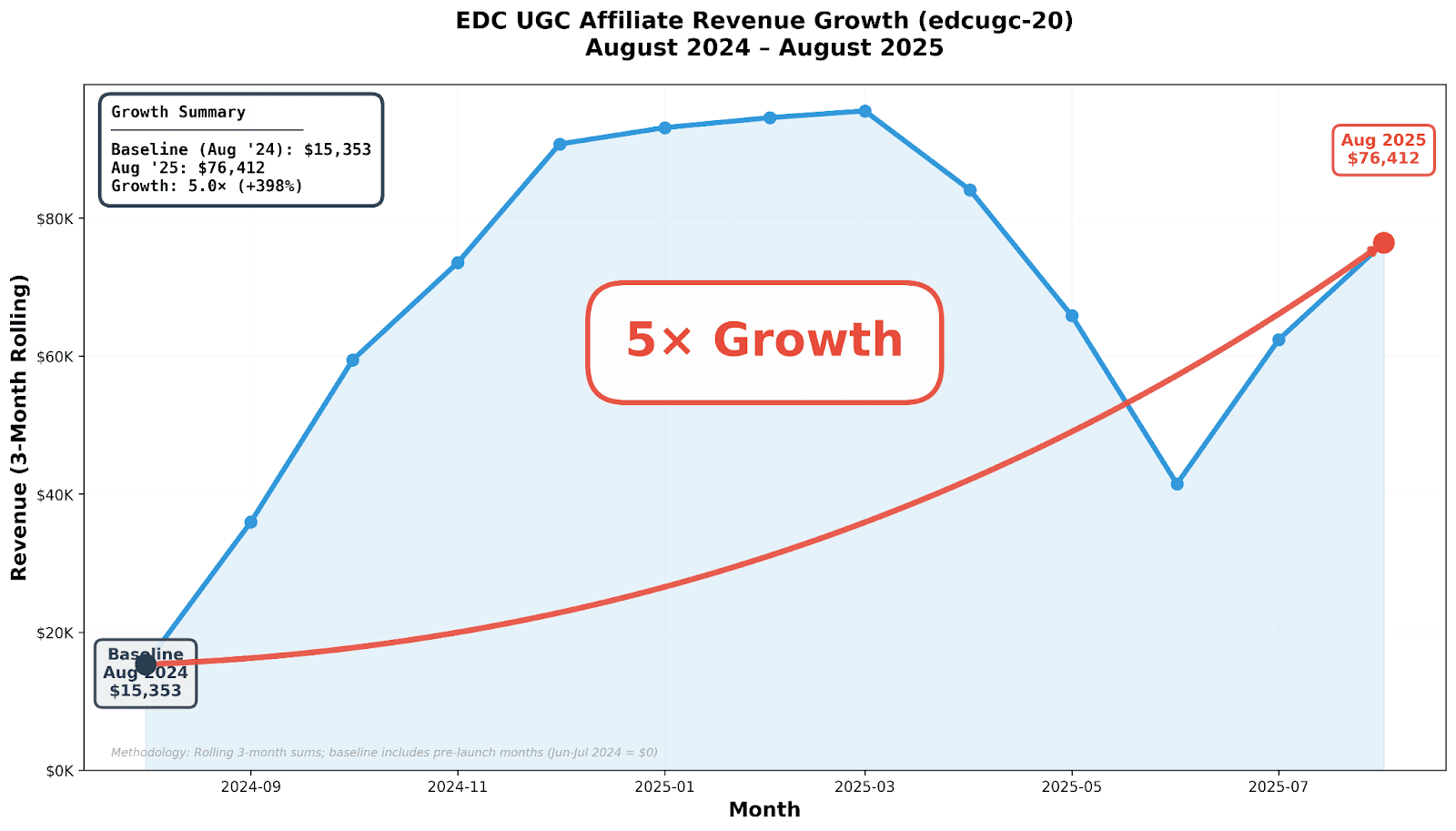
When I gave the UGC approach real infrastructure in August 2024, the results validated what I'd always believed about this format.
Over the following year, UGC affiliate revenue grew approximately 5x year over year (≈398% on a rolling three-month basis, Aug '24 to Aug '25), tracked via the dedicated edcugc-20 affiliate tag. On TikTok, the UGC-style videos delivered 4.38M organic views across 16 videos in 2025 and grew the channel's audience 27% (from 85K to 105K), ending a plateau that had persisted for over a year.
The format also drove discoverability through Google Discover, supplementing traditional search traffic in a way the buying guides alone couldn't. And the system increased overall publishing output. UGC was free to source, submissions came in consistently, and the per-submission production cost was low relative to original content. That meant I could publish more frequently without increasing the team or the budget.
What I Learned
From the outset, my perspective was unique and my strategy was strong. But the landscape, the headwinds, and the challenges all change over time.
I turned up the volume on the signals everyone else was broadcasting, hoping for answers. Amidst the threats of new competition, platform changes, and audience distrust, those answers only kept me afloat. And at the same level as everyone else. They drowned out the quiet truth that was there all along.
Once I started to tune out their signals and sit with the static and listen, I could hear that what was needed was different. And because it was different, it was left unsaid. I returned to my roots and became that voice once again.
Finding the right signal in all this noise didn't happen by chance. It was the result of 15 years embedded in the space, observing what came and went, and persisting nonetheless. Everyday Carry might not have had the same peaks and virality as its competitors, but it has the longevity. And it's because I chose to do things differently that it's still here today.
That willingness to challenge convention—to lean into what’s unique not simply because it’s different but because it’s truly valuable—grounded some of my best strategic decisions. In a word: taste. It’s something that can’t be generated. And it’s something I’ll carry with me throughout my career.
Notes
Metrics tracked include UGC affiliate revenue (Amazon Associates, edcugc-20 tag) and TikTok audience/view data.
Customer acquisition cost and lifetime value were not measured in this system.